






Diese Website verwendet Cookies und ähnliche Technologien. Dabei handelt es sich um kleine Textdateien, die auf eurem Computer gespeichert und ausgelesen werden. Indem ihr auf "Alles akzeptieren" klickt, stimmt ihr der Verarbeitung von Daten, der Erstellung und Verarbeitung von individuellen Nutzungsprofilen über Websites und über Partner und Geräte hinweg sowie der Übermittlung eurer Daten an Drittanbieter zu, die eure Daten teilweise in Ländern außerhalb der Europäischen Union verarbeiten (GDPR Art. 49). Einzelheiten hierzu findet ihr in den Datenschutzhinweisen. Die Daten werden für Analysen und für eigene Zwecke Dritter verwendet. Weitere Informationen, auch über die Datenverarbeitung durch Drittanbieter und die Möglichkeit des Widerrufs, findet ihr in den Einstellungen und in unseren Datenschutzhinweisen. Hier könnt ihr mit den notwendigen Tools fortfahren.
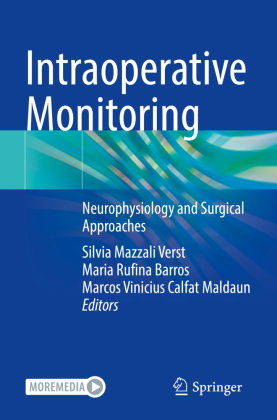
- Verlag: Springer, Berlin
- Autor: Silvia Mazzali Verst
- Artikel-Nr.: KNV96675158
- ISBN: 9783030957322
In recent decades, the advances in and consolidation of Intraoperative Neurophysiological Monitoring (IOM) in several highly complex surgical areas have been undeniable.
Currently all modalities of neurophysiological tests (SSEP, MEP, EMG, PEATC, VEP, BRAIN MAPPING, ETC) are performed in the operating room, where they are used to provide trans operative information on the patient's neurological status in real time (monitoring), and to identify neural structures which are at immediate risk (mapping).
With the inarguably positive impact of IOM on surgical outcomes, there is an increasing interest in reliable, technically focused literature. This volume provides cutting-edge information in the field of IOM, and highlights new neurophysiological tools being used in various surgeries.
The book's initial sections cover a range of topics, including an anatomical overview, electrical safety, and detailed technical descriptions of the neurophysiological tests used inIOM. The subsequent sections address e.g. the brain, brainstem, spinal cord, vascular and peripheral nerves, epilepsy, head and neck, movement disorders and special topics.
Some chapters are accompanied by videos of surgeries and IOM so that the reader will have the real sensation of having been in the operating room and will gain an overview of the key steps.
Written by experts in the field of IOM, the book offers a valuable resource for both experienced and early-career neurophysiologists, neurosurgeons, vascular and orthopedic surgeons, and surgeons involved with pelvic procedures. Further, its goal is to provide a real rapport, never before attained, between neurophysiologists and surgeons with a sole focus: excellence in terms of the final outcome.