






Diese Website verwendet Cookies und ähnliche Technologien. Dabei handelt es sich um kleine Textdateien, die auf eurem Computer gespeichert und ausgelesen werden. Indem ihr auf "Alles akzeptieren" klickt, stimmt ihr der Verarbeitung von Daten, der Erstellung und Verarbeitung von individuellen Nutzungsprofilen über Websites und über Partner und Geräte hinweg sowie der Übermittlung eurer Daten an Drittanbieter zu, die eure Daten teilweise in Ländern außerhalb der Europäischen Union verarbeiten (GDPR Art. 49). Einzelheiten hierzu findet ihr in den Datenschutzhinweisen. Die Daten werden für Analysen und für eigene Zwecke Dritter verwendet. Weitere Informationen, auch über die Datenverarbeitung durch Drittanbieter und die Möglichkeit des Widerrufs, findet ihr in den Einstellungen und in unseren Datenschutzhinweisen. Hier könnt ihr mit den notwendigen Tools fortfahren.
- Verlag: Springer, Berlin
- Autor: Vinit Kumar Gunjan
- Artikel-Nr.: KNV96736944
- ISBN: 9783031430084
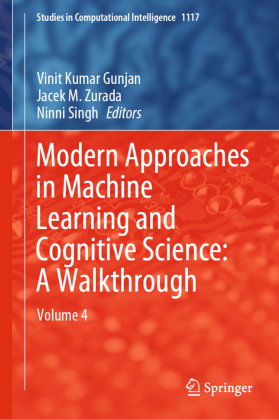
The book contains contents highlighting artificial neural networks that are analogous to the networks of neurons that comprise the brain and have given computers the ability to distinguish an image of a cat from one of a coconut, to spot pedestrians with enough accuracy to direct a self-driving car, and to recognize and respond to the spoken word. The chapters in this book focus on audiences interested in artificial intelligence, machine learning, fuzzy, cognitive and neurofuzzy-inspired computational systems, their theories, mechanisms, and architecture, which underline human and animal behavior, and their application to conscious and intelligent systems. In the current version, it focuses on the successful implementation and step-by-step execution and explanation of practical applications of the domain. It also offers a wide range of inspiring and interesting cutting-edge contributions on applications of machine learning, artificial intelligence, and cognitive science such as healthcare products, AI-enabled IoT, gaming, medical, and engineering.
Overall, this book provides valuable information on effective, cutting-edge techniques, and approaches for students, researchers, practitioners, and academics in the field of machine learning and cognitive science. Furthermore, the purpose of this book is to address the interests of a broad spectrum of practitioners, students, and researchers, who are interested in applying machine learning and cognitive science methods in their respective domains.