






Diese Website verwendet Cookies und ähnliche Technologien. Dabei handelt es sich um kleine Textdateien, die auf eurem Computer gespeichert und ausgelesen werden. Indem ihr auf "Alles akzeptieren" klickt, stimmt ihr der Verarbeitung von Daten, der Erstellung und Verarbeitung von individuellen Nutzungsprofilen über Websites und über Partner und Geräte hinweg sowie der Übermittlung eurer Daten an Drittanbieter zu, die eure Daten teilweise in Ländern außerhalb der Europäischen Union verarbeiten (GDPR Art. 49). Einzelheiten hierzu findet ihr in den Datenschutzhinweisen. Die Daten werden für Analysen und für eigene Zwecke Dritter verwendet. Weitere Informationen, auch über die Datenverarbeitung durch Drittanbieter und die Möglichkeit des Widerrufs, findet ihr in den Einstellungen und in unseren Datenschutzhinweisen. Hier könnt ihr mit den notwendigen Tools fortfahren.
- Verlag: Springer, Berlin
- Autor: Shuang Li
- Artikel-Nr.: KNV96750205
- ISBN: 9789819962815
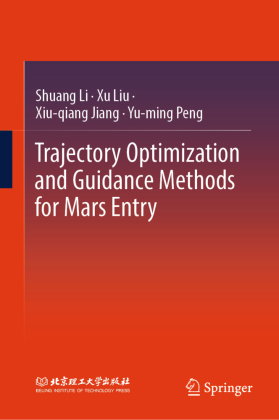
This book systematically investigates the Mars entry problem from the perspectives of deterministic optimization, uncertainty optimization, and guidance. Began with a detailed review of the robotic missions and human-scaled exploration plans to Mars, theories or concepts of optimal control, uncertainty quantification, robust optimization, model predictive control, sequential convex programming, and computational guidance are subsequently introduced. Correspondingly, this book presents a series of trajectory planning and guidance algorithms to improve the robustness, reliability, and safety of the Mars missions. Because the Mars entry problem is studied using advanced mathematics, including probability theory, optimization theory, and cybernetics, thus the book is primarily designed as a textbook for graduate students in aerospace engineering, aeronautics, and astronautics departments. Engineers and researchers may also use this book as a reference or tutorial to help with the modeling and simulation of the Mars entry problem due to its thorough simulations and analyses.