






Diese Website verwendet Cookies und ähnliche Technologien. Dabei handelt es sich um kleine Textdateien, die auf eurem Computer gespeichert und ausgelesen werden. Indem ihr auf "Alles akzeptieren" klickt, stimmt ihr der Verarbeitung von Daten, der Erstellung und Verarbeitung von individuellen Nutzungsprofilen über Websites und über Partner und Geräte hinweg sowie der Übermittlung eurer Daten an Drittanbieter zu, die eure Daten teilweise in Ländern außerhalb der Europäischen Union verarbeiten (GDPR Art. 49). Einzelheiten hierzu findet ihr in den Datenschutzhinweisen. Die Daten werden für Analysen und für eigene Zwecke Dritter verwendet. Weitere Informationen, auch über die Datenverarbeitung durch Drittanbieter und die Möglichkeit des Widerrufs, findet ihr in den Einstellungen und in unseren Datenschutzhinweisen. Hier könnt ihr mit den notwendigen Tools fortfahren.
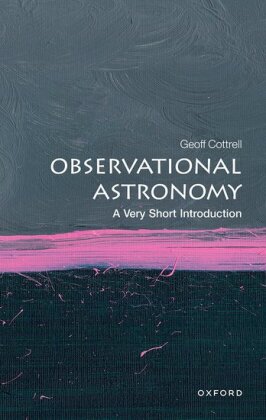
- Verlag: Oxford University Press
- Autor: Geoff Cottrell
- Artikel-Nr.: KNV96905946
- ISBN: 9780192849021
Almost everything we know about the Universe has come from studying the messages carried by light from outer space. Until only a handful of decades ago, this meant observing optical photons in the narrow visible region of the electromagnetic spectrum. However, recent technological developments have now enabled us to extend this range and explore the Universe at radio, infrared, ultraviolet, X-ray, and gamma-ray wavelengths. The observations reveal a plethora of exotic phenomena such as young galaxies at the edge of the visible Universe, quasars, pulsars, colliding galaxies, and exploding stars, often at great distances. We have discovered that the Universe is expanding and that the expansion itself is accelerating. Closer to our home planet, we track killer asteroids and comets. Working closely together, observational astronomy and astrophysics have shown us how stars produce their energy, where the chemical elements come from, how black holes form, and how the giant supermassive black holes lurking in the hearts of galaxies spew immensely powerful jets of particles and energy thousands of light years out into space.
And we now have new ways beyond light to probe the mysteries of the Universe. This Very Short Introduction describes how neutrinos and gravitational waves are revolutionizing our knowledge. How do we know all this? Advances in telescope technologies offer a partial explanation, but technology alone is not enough. Unlocking the secrets of the Universe also involves the critical application of the laws of physics to the observations. Cottrell describes how we are turning observations into knowledge and how theory, in turn, is inspiring new observations.
ABOUT THE SERIES: The Very Short Introductions series from Oxford University Press contains hundreds of titles in almost every subject area. These pocket-sized books are the perfect way to get ahead in a new subject quickly. Our expert authors combine facts, analysis, perspective, new ideas, and enthusiasm to make interesting and challenging topics highly readable.