






Diese Website verwendet Cookies und ähnliche Technologien. Dabei handelt es sich um kleine Textdateien, die auf eurem Computer gespeichert und ausgelesen werden. Indem ihr auf "Alles akzeptieren" klickt, stimmt ihr der Verarbeitung von Daten, der Erstellung und Verarbeitung von individuellen Nutzungsprofilen über Websites und über Partner und Geräte hinweg sowie der Übermittlung eurer Daten an Drittanbieter zu, die eure Daten teilweise in Ländern außerhalb der Europäischen Union verarbeiten (GDPR Art. 49). Einzelheiten hierzu findet ihr in den Datenschutzhinweisen. Die Daten werden für Analysen und für eigene Zwecke Dritter verwendet. Weitere Informationen, auch über die Datenverarbeitung durch Drittanbieter und die Möglichkeit des Widerrufs, findet ihr in den Einstellungen und in unseren Datenschutzhinweisen. Hier könnt ihr mit den notwendigen Tools fortfahren.
- Verlag: Springer, Berlin
- Autor: Yann Bouchery
- Artikel-Nr.: KNV96928333
- ISBN: 9783031455643
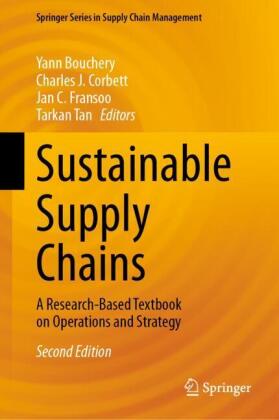
This book is primarily intended to serve as a research-based textbook on sustainable supply chains for graduate programs in business, management, industrial engineering, and industrial ecology, but should also be of interest to researchers in the broader sustainable supply chain space, whether from the operations management and industrial engineering side or more from the industrial ecology and life-cycle assessment side.
As firms become ever more tightly coupled in global supply chains, rather than being large and vertically integrated monoliths, the risks and opportunities associated with activities upstream or downstream will increasingly affect their own wellbeing. For firms to thrive, it is increasingly imperative that they be aware of the economic, environmental and social dimensions of the supply chains they operate in, and that they proactively monitor and manage them. Finding effective solutions towards a more sustainable supply chain is increasingly important for managers, but raises difficult questions, often without clear answers. This book provides students and practitioners valuable insights into these kinds of questions, based on the latest academic research.Chapter "Food Loss, Food Waste, and Sustainability in Food Supply Chains" is available open access under a Creative Commons Attribution 4.0 International License via link.springer.com.