






Diese Website verwendet Cookies und ähnliche Technologien. Dabei handelt es sich um kleine Textdateien, die auf eurem Computer gespeichert und ausgelesen werden. Indem ihr auf "Alles akzeptieren" klickt, stimmt ihr der Verarbeitung von Daten, der Erstellung und Verarbeitung von individuellen Nutzungsprofilen über Websites und über Partner und Geräte hinweg sowie der Übermittlung eurer Daten an Drittanbieter zu, die eure Daten teilweise in Ländern außerhalb der Europäischen Union verarbeiten (GDPR Art. 49). Einzelheiten hierzu findet ihr in den Datenschutzhinweisen. Die Daten werden für Analysen und für eigene Zwecke Dritter verwendet. Weitere Informationen, auch über die Datenverarbeitung durch Drittanbieter und die Möglichkeit des Widerrufs, findet ihr in den Einstellungen und in unseren Datenschutzhinweisen. Hier könnt ihr mit den notwendigen Tools fortfahren.
- Verlag: Springer, Berlin
- Autor: Tijmen Jan Moser
- Artikel-Nr.: KNV96939688
- ISBN: 9783031461576
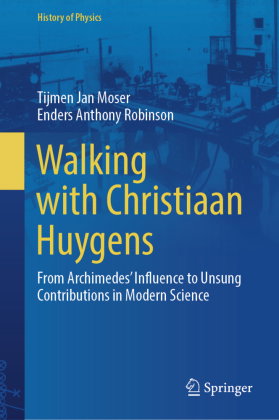
Dutch scientist Christiaan Huygens (1629-1695) left an indelible mark on the fields of mathematics, physics, astronomy, and geophysics. Despite his groundbreaking contributions, history has often overlooked his pivotal role. While two of the most famous achievements in physics are Newton's theory of gravity and Einstein's general theory of relativity, less well-known is that Huygens provided central elements to these theories. This book stands to correct that deficit. For example, we show how Huygens used symmetry arguments to derive conservation laws for momentum and for energy, and what Einstein later called the principle of equivalence to derive the formula for centrifugal force.
In 1689, Huygens visited Newton. Together, they walked the streets of London. Newton had recently finished his masterpiece, Principia, expounding his laws of motion and the law of universal gravitation. Huygens had essentially completed his life's work by then, building on Archimedes, Leonardo da Vinci, Galileo, Descartes, Fermat, Pascal and his own ingenuity. He had established fame as an instrument maker (telescope, pendulum clock, planetarium). He had invented the 31 tone system. He had pioneered the first principles of remote sensing. He had discovered the rings of Saturn. He had formulated the wave theory of light. What would walking with Christiaan reveal? This book gives the result in nine chapters, namely: spontaneous order, the speed of light, Huygens' principle, the telescope, the pendulum clock, Huygens-Fresnel principle, special relativity, centrifugal force, and curvature. In addition, there is a chapter titled What Huygens could have written on diffraction, and a chapter titled Huygens and Geophysics. Mentally walking with Christiaan, browsing his collected works - a true treasure trove for puzzle enthusiasts - and rethinking his ideas creates a vivid impression of scientific life in the 17th century, an appreciation that it is remarkably similar to ours, and an understanding of Huygens' significant and lasting contributions to science.