






Diese Website verwendet Cookies und ähnliche Technologien. Dabei handelt es sich um kleine Textdateien, die auf eurem Computer gespeichert und ausgelesen werden. Indem ihr auf "Alles akzeptieren" klickt, stimmt ihr der Verarbeitung von Daten, der Erstellung und Verarbeitung von individuellen Nutzungsprofilen über Websites und über Partner und Geräte hinweg sowie der Übermittlung eurer Daten an Drittanbieter zu, die eure Daten teilweise in Ländern außerhalb der Europäischen Union verarbeiten (GDPR Art. 49). Einzelheiten hierzu findet ihr in den Datenschutzhinweisen. Die Daten werden für Analysen und für eigene Zwecke Dritter verwendet. Weitere Informationen, auch über die Datenverarbeitung durch Drittanbieter und die Möglichkeit des Widerrufs, findet ihr in den Einstellungen und in unseren Datenschutzhinweisen. Hier könnt ihr mit den notwendigen Tools fortfahren.
- Verlag: Springer, Berlin
- Autor: Abdelazim M. Negm
- Artikel-Nr.: KNV96939683
- ISBN: 9783031464904
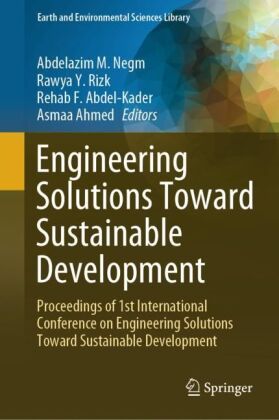
This book constitutes the referred proceeding of the 1st International Conference on Engineering Solutions Toward Sustainable development (ESSD2023), organized by the Faculty of Engineering, Port Said University and held in Port Said, Egypt, during May 2-3, 2023.
The book is devoted to fulfill the need for sustainable development that has never been more urgent. It shows the crucial role of engineering to play in this transition from consumption culture to responsible culture. This book explores the relationship between engineering and sustainability, highlighting the vital role that engineering plays in achieving sustainable development. The book provides a comprehensive guide for engineers, researchers, and experts from different disciplines that are interested in sustainable development. From renewable energy sources to green infrastructure, the book delves into the latest technological advancements providing insights and practical strategies for designing and implementing sustainable solutions. With practical examples and case studies, readers will gain a deep understanding of how engineering principles and practices can be harnessed to develop sustainable solutions that balance economic, social, and environmental needs and to mitigate the negative impacts of human activity on our planet. The books is very useful for graduate students, researchers, policy planners, decision makers and stakeholders in the field of renewable energy, clean water development, climate actions, smart cities and communities and green infrastructures.