






Diese Website verwendet Cookies und ähnliche Technologien. Dabei handelt es sich um kleine Textdateien, die auf eurem Computer gespeichert und ausgelesen werden. Indem ihr auf "Alles akzeptieren" klickt, stimmt ihr der Verarbeitung von Daten, der Erstellung und Verarbeitung von individuellen Nutzungsprofilen über Websites und über Partner und Geräte hinweg sowie der Übermittlung eurer Daten an Drittanbieter zu, die eure Daten teilweise in Ländern außerhalb der Europäischen Union verarbeiten (GDPR Art. 49). Einzelheiten hierzu findet ihr in den Datenschutzhinweisen. Die Daten werden für Analysen und für eigene Zwecke Dritter verwendet. Weitere Informationen, auch über die Datenverarbeitung durch Drittanbieter und die Möglichkeit des Widerrufs, findet ihr in den Einstellungen und in unseren Datenschutzhinweisen. Hier könnt ihr mit den notwendigen Tools fortfahren.
- Verlag: Wiley-VCH
- Autor: Xiao-Feng Wu
- Artikel-Nr.: KNV96953509
- ISBN: 9783527352005
Essential reference on replacing conventional solvents with greener alternatives in industrial chemicals synthesis and production
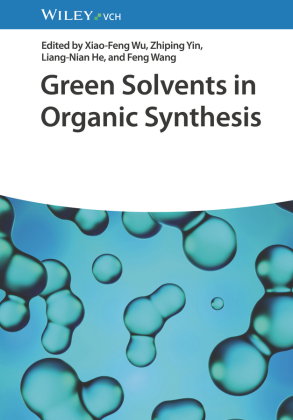
A well-timed book promoting sustainability in synthesis and production of chemicals, Green Solvents in Organic Synthesis details various green solvents, solvent systems, and solubilization techniques, including their chemistry, physiochemical properties, performance, and distinct applications, presenting a greener approach to conventional solvents by replacing them with sustainable alternatives that have similarities in their reaction mechanisms.
Edited by four highly qualified academics with significant research experience in the field, Green Solvents in Organic Synthesis includes information on:
* Water and liquid polymers (Polyethylene glycol PEG), Acetonitrile, DMSO, Dimethyl carbonate, Ionic liquids, and Supercritical fluids)
* Bio-based solvents (Cyrene, ¿-Valerolactone (GVL), Lactic acid, 2-MeTHF) and deep eutectic solvents (DESs)
* Alcohols (MeOH, EtOH, i-PrOH, n-BuOH, t-BuOH, Ethylene glycol), ketones (Acetones, MEK, MIBK, Cyclohexanone), and esters (Methyl acetate, Ethyl acetate, i-PrOAc, n-BuOAc)
* Technical, economic, and environmental aspects of green solvents and how to maximize their reuse and recycling to alleviate pollution and reduce energy consumption
For chemists in a variety of disciplines, Green Solvents in Organic Synthesis is an essential reference that provides foundational knowledge of green solvents, along with key features of each class of green solvent within the context of organic reactions for industrial and laboratory synthesis.