






Diese Website verwendet Cookies und ähnliche Technologien. Dabei handelt es sich um kleine Textdateien, die auf eurem Computer gespeichert und ausgelesen werden. Indem ihr auf "Alles akzeptieren" klickt, stimmt ihr der Verarbeitung von Daten, der Erstellung und Verarbeitung von individuellen Nutzungsprofilen über Websites und über Partner und Geräte hinweg sowie der Übermittlung eurer Daten an Drittanbieter zu, die eure Daten teilweise in Ländern außerhalb der Europäischen Union verarbeiten (GDPR Art. 49). Einzelheiten hierzu findet ihr in den Datenschutzhinweisen. Die Daten werden für Analysen und für eigene Zwecke Dritter verwendet. Weitere Informationen, auch über die Datenverarbeitung durch Drittanbieter und die Möglichkeit des Widerrufs, findet ihr in den Einstellungen und in unseren Datenschutzhinweisen. Hier könnt ihr mit den notwendigen Tools fortfahren.
- Verlag: Springer, Berlin
- Autor: Güliz Karaarslan-Semiz
- Artikel-Nr.: KNV96973672
- ISBN: 9783031091148
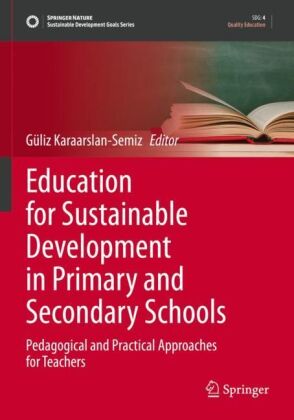
This volume provides teachers with pedagogical approaches and practical applications to implement Education for Sustainable Development (ESD), and with assessment strategies to evaluate the learning outcomes of ESD in primary and secondary education. In addition to appropriate pedagogical approaches for ESD, the book also presents practical examples that teachers can use as a guide in their classes. The pedagogical approaches related to ESD not only aim to facilitate sustainability knowledge, but also promote attitudes, new perspectives, values, skills and competencies related to sustainability. Thus, holistic and transformative approaches are embraced to develop a deeper understanding of sustainability, values, respect towards the environment, connection to nature, systems thinking to understand complex problems, exhibiting responsible behaviours for sustainability and promoting action competence for sustainable development.
This book also provides examples of assessment strategies for ESD. The assessment of ESD learning outcomes and learning processes is usually challenging, but it is important to determine how to evaluate ESD learning outcomes to reveal whether we achieve our ESD goals or not. For this reason, the assessment section of the book includes theoretical concepts and measurement tools for evaluating sustainability competencies and learning outcomes. Through the close and active collaboration of 22 authors from Germany, Italy, Slovenia, Sweden, Turkey, and the UK, good models for ESD implementation in primary and secondary education are presented.