






Diese Website verwendet Cookies und ähnliche Technologien. Dabei handelt es sich um kleine Textdateien, die auf eurem Computer gespeichert und ausgelesen werden. Indem ihr auf "Alles akzeptieren" klickt, stimmt ihr der Verarbeitung von Daten, der Erstellung und Verarbeitung von individuellen Nutzungsprofilen über Websites und über Partner und Geräte hinweg sowie der Übermittlung eurer Daten an Drittanbieter zu, die eure Daten teilweise in Ländern außerhalb der Europäischen Union verarbeiten (GDPR Art. 49). Einzelheiten hierzu findet ihr in den Datenschutzhinweisen. Die Daten werden für Analysen und für eigene Zwecke Dritter verwendet. Weitere Informationen, auch über die Datenverarbeitung durch Drittanbieter und die Möglichkeit des Widerrufs, findet ihr in den Einstellungen und in unseren Datenschutzhinweisen. Hier könnt ihr mit den notwendigen Tools fortfahren.
- Verlag: De Gruyter
- Autor: Concepción Cabrillana
- Artikel-Nr.: KNV96974246
- ISBN: 9783110721669
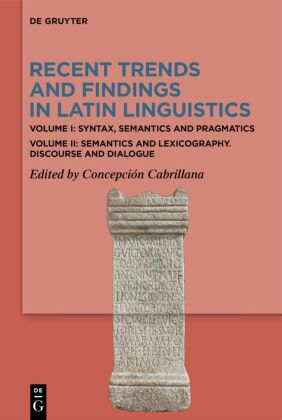
These volumes contain a selection of contributions first presented at the 21st International Colloquium on Latin Linguistics, held in Santiago de Compostela (2022). They cover essential topics in Latin linguistics from a variety of theoretical and methodological approaches.
The first volume includes papers on Latin Syntax and Semantics, Latin Syntax and Pragmatics, Greek-Latin language, and Digital Linguistics. The contributions report on the latest research into very relevant issues in specific areas such as definiteness, casual syntax, sentence structure, word order, etc.; in addition, the most recent methodological advances using a variety of databases, a key tool in contemporary research, are presented.
The second volume includes papers on Semantics and Lexicography, Etymology, Discourse strategies, and a special section devoted to the analysis of Conversation and Dialogue. The contributions report on the latest research into highly relevant issues in specific areas such as nominal and adjectival lexicology from both a synchronic and a diachronic perspectives, the use of Greek words as a vehicle for the expression of philosophical concepts, the choice and rendering of various linguistic strategies in direct and indirect discourse, etc. A particularly innovative section deals with various aspects of conversational language in a number of text types, as well as the use of different devices that contribute to the expression of (im)politeness by participants in the speech act.
A knowledge of the work collected in these volumes is essential for all those involved in research in the field of Latin linguistics.