






Diese Website verwendet Cookies und ähnliche Technologien. Dabei handelt es sich um kleine Textdateien, die auf eurem Computer gespeichert und ausgelesen werden. Indem ihr auf "Alles akzeptieren" klickt, stimmt ihr der Verarbeitung von Daten, der Erstellung und Verarbeitung von individuellen Nutzungsprofilen über Websites und über Partner und Geräte hinweg sowie der Übermittlung eurer Daten an Drittanbieter zu, die eure Daten teilweise in Ländern außerhalb der Europäischen Union verarbeiten (GDPR Art. 49). Einzelheiten hierzu findet ihr in den Datenschutzhinweisen. Die Daten werden für Analysen und für eigene Zwecke Dritter verwendet. Weitere Informationen, auch über die Datenverarbeitung durch Drittanbieter und die Möglichkeit des Widerrufs, findet ihr in den Einstellungen und in unseren Datenschutzhinweisen. Hier könnt ihr mit den notwendigen Tools fortfahren.
- Verlag: Springer, Berlin
- Autor: Fabrizio Baldassarri
- Artikel-Nr.: KNV96986867
- ISBN: 9783031486623
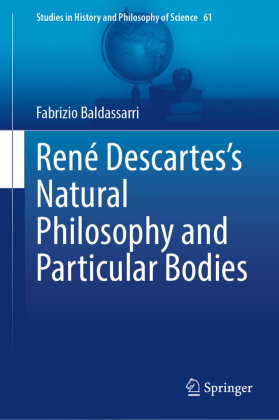
This book explores René Descartes's attempts to describe particular bodies, such as rocks, minerals, metals, plants, and animals, within the mechanistic interpretation of nature of his philosophical program. Despite his early rationalistic epistemology, Descartes's increasing attention to collections, histories, lists of qualities, and particular bodies results in a puzzling 'short history of all natural phenomena' contained in the Principles of philosophy (1644). The present book outlines the role of Descartes's observations and experimentation as he aimed to construct a universal science of nature, ultimately revealing the mechanization of nature in detail, and for curious bodies such as the Bologna Stone or the sensitive herb. What results is a theoretical natural history consistent with the mechanical principles of his philosophy, ultimately shedding new light on his attempt to produce a complete philosophy of nature.