






Diese Website verwendet Cookies und ähnliche Technologien. Dabei handelt es sich um kleine Textdateien, die auf eurem Computer gespeichert und ausgelesen werden. Indem ihr auf "Alles akzeptieren" klickt, stimmt ihr der Verarbeitung von Daten, der Erstellung und Verarbeitung von individuellen Nutzungsprofilen über Websites und über Partner und Geräte hinweg sowie der Übermittlung eurer Daten an Drittanbieter zu, die eure Daten teilweise in Ländern außerhalb der Europäischen Union verarbeiten (GDPR Art. 49). Einzelheiten hierzu findet ihr in den Datenschutzhinweisen. Die Daten werden für Analysen und für eigene Zwecke Dritter verwendet. Weitere Informationen, auch über die Datenverarbeitung durch Drittanbieter und die Möglichkeit des Widerrufs, findet ihr in den Einstellungen und in unseren Datenschutzhinweisen. Hier könnt ihr mit den notwendigen Tools fortfahren.
- Verlag: Springer, Berlin
- Autor: Federica Ronchetti
- Artikel-Nr.: KNV97010084
- ISBN: 9783031496912
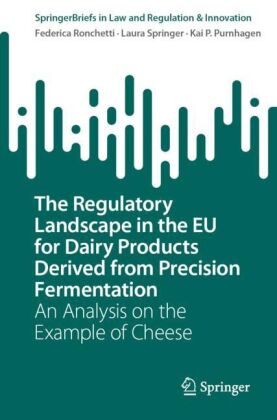
This book assesses the EU legal framework applicable to dairy products obtained through precision fermentation. It maps the authorisation and labelling requirements for these products to be placed on the EU market. It compares these provisions to those governing the food markets in the USA and Singapore, which are considered to be more innovation-friendly. At the time of writing, the precision-fermented dairy sector is still in the developmental phase, with only a few precision-fermented dairy alternatives available on the market, none of which are present in the EU. Regulatory uncertainty has been cited as significant obstacle for food business operators seeking to introduce alternative protein products in the EU. The book confirms these reports, as the current EU regulatory framework presents several legal uncertainties that are challenging for food business operators to overcome. Broadly speaking, there are two authorisation frameworks applicable to dairy products obtained through precision fermentation in the EU. The choice between these frameworks depends on the presence of genetically modified organisms (GMOs) or residues thereof in the final product. If such GMOs or residues are present, the pre-market authorisation procedure is governed by the Genetically Modified Food and Feed Regulation (GMFR). If the final product does not contain any GMOs or residues, it falls under the scope of the Novel Food Regulation (NFR), and the pre-market authorisation procedure is governed accordingly. Both of these authorisation pathways entail high regulatory requirements, which can pose challenges for the development of the precision fermentation sector. Despite the difficulty in accurately classifying products, it is crucial for food business operators to comprehend the applicable legal framework early in the product development process, given that the authorisation paths differ in their standards. In addition to pre-market authorisation requirements, companies must address labelling issues. Food labelling shall provide a basis for consumers to make informed choices in relation to the foods they consume. The primary objective of EU food labelling law is to prevent consumer deception , making it crucial for dairy products and their animal-free alternatives, to adhere to a stringent naming law as stipulated in the Common Market Organisation and specific accompanying legislation. Moreover, it is imperative to consider regulations regarding the use of health and nutrition claims, as well as labels such as "vegan" or "organic", etc. Furthermore, the labelling of novel foods and genetically modified foods may necessitate mandatory information specified in the authorisation process. The book serves as a comprehensive guideline for food business operators involved in the production of precision-fermented dairy alternatives, aiding them in navigating the intricate European regulatory landscape.