






Diese Website verwendet Cookies und ähnliche Technologien. Dabei handelt es sich um kleine Textdateien, die auf eurem Computer gespeichert und ausgelesen werden. Indem ihr auf "Alles akzeptieren" klickt, stimmt ihr der Verarbeitung von Daten, der Erstellung und Verarbeitung von individuellen Nutzungsprofilen über Websites und über Partner und Geräte hinweg sowie der Übermittlung eurer Daten an Drittanbieter zu, die eure Daten teilweise in Ländern außerhalb der Europäischen Union verarbeiten (GDPR Art. 49). Einzelheiten hierzu findet ihr in den Datenschutzhinweisen. Die Daten werden für Analysen und für eigene Zwecke Dritter verwendet. Weitere Informationen, auch über die Datenverarbeitung durch Drittanbieter und die Möglichkeit des Widerrufs, findet ihr in den Einstellungen und in unseren Datenschutzhinweisen. Hier könnt ihr mit den notwendigen Tools fortfahren.
- Verlag: Academic Press
- Autor: Vincent Ball
- Artikel-Nr.: KNV65312542
- ISBN: 9780128019702
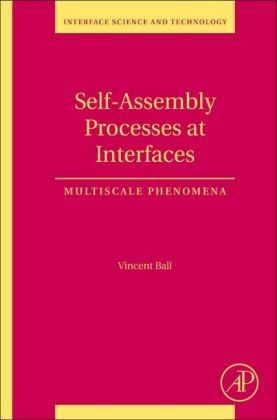
Self-Assembly Processes at Interfaces: Multiscale Phenomena provides the conceptual and unifying view of adsorption, self-assembly, and grafting processes at solid-liquid and liquid-gas interfaces, also describing experimental methods where applicable.
An invaluable resource for (post)-graduate students looking to bridge the gap between acquiring the field's existing knowledge and the creation of new insights, the book recalls fundamental concepts, giving rigorous, but first-principle-based, calculations and exercises, and showing how these concepts have been used in recent research articles.
Readers will find guidelines on how best to start research in the field of surface chemistry with biological macromolecules and molecules able to undergo self-assembly process at interfaces in the presence of a liquid, along with discussions on the very fundamental aspects and applications using concepts of biomimetic chemistry.
By highlighting the interdisciplinary aspects of the field of self-assembly at interfaces, the book is an ideal resource for chemical engineers, chemists, physicists, and biologists. In addition, important equations are demonstrated on the basis of fundamental concepts, and overly complex mathematical developments are avoided.