






Diese Website verwendet Cookies und ähnliche Technologien. Dabei handelt es sich um kleine Textdateien, die auf eurem Computer gespeichert und ausgelesen werden. Indem ihr auf "Alles akzeptieren" klickt, stimmt ihr der Verarbeitung von Daten, der Erstellung und Verarbeitung von individuellen Nutzungsprofilen über Websites und über Partner und Geräte hinweg sowie der Übermittlung eurer Daten an Drittanbieter zu, die eure Daten teilweise in Ländern außerhalb der Europäischen Union verarbeiten (GDPR Art. 49). Einzelheiten hierzu findet ihr in den Datenschutzhinweisen. Die Daten werden für Analysen und für eigene Zwecke Dritter verwendet. Weitere Informationen, auch über die Datenverarbeitung durch Drittanbieter und die Möglichkeit des Widerrufs, findet ihr in den Einstellungen und in unseren Datenschutzhinweisen. Hier könnt ihr mit den notwendigen Tools fortfahren.
- Verlag: Springer, Berlin
- Autor: Ali H. A. Al-Waeli
- Artikel-Nr.: KNV97042313
- ISBN: 9789819991259
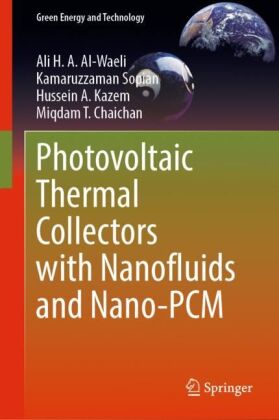
This book gives you theory and design of PV/T systems. Are you interested in solar energy? If you are, you must have read about solar panels, or photovoltaics (PV). If you have installed a photovoltaic system, you must have noticed it not to generate the amount of power mentioned in its datasheet. A major issue that PV suffers from is its temperature, which causes a drop in its power. Among the solutions to this issue is to use active cooling methods, such as the hybrid photovoltaic thermal (PV/T) system. These systems can produce electrical and thermal energy simultaneously and within same area. The thermal collector serves to cool down the PV surface temperature, which negatively affects the PV efficiency, to reclaim the efficiency or bring it back close to standard testing conditions value. Moreover, the thermal collector will convey this heat using a working fluid and extract it as thermal energy. On the other hand, the electrical power generated from the PV can be utilized in standalone or grid-connected configuration. Moreover, the book presents a novel PV/T collector which can utilize nanofluids and nano-Phase Change Material (PCM) to enhance its performance in tropical climate conditions. The methods used to develop the heat transfer and energy balance equations are presented as well. PV/T collector numerical simulation using MATLAB and computational fluid dynamic (CFD) was also presented. Finally, the approach of life cycle cost analysis (LCCA) is presented to evaluate PV/T with nanofluid and nano-PCM, economically.