






Diese Website verwendet Cookies und ähnliche Technologien. Dabei handelt es sich um kleine Textdateien, die auf eurem Computer gespeichert und ausgelesen werden. Indem ihr auf "Alles akzeptieren" klickt, stimmt ihr der Verarbeitung von Daten, der Erstellung und Verarbeitung von individuellen Nutzungsprofilen über Websites und über Partner und Geräte hinweg sowie der Übermittlung eurer Daten an Drittanbieter zu, die eure Daten teilweise in Ländern außerhalb der Europäischen Union verarbeiten (GDPR Art. 49). Einzelheiten hierzu findet ihr in den Datenschutzhinweisen. Die Daten werden für Analysen und für eigene Zwecke Dritter verwendet. Weitere Informationen, auch über die Datenverarbeitung durch Drittanbieter und die Möglichkeit des Widerrufs, findet ihr in den Einstellungen und in unseren Datenschutzhinweisen. Hier könnt ihr mit den notwendigen Tools fortfahren.
- Verlag: Springer, Berlin
- Autor: Heather K. Caldwell
- Artikel-Nr.: KNV97045892
- ISBN: 9783031511110
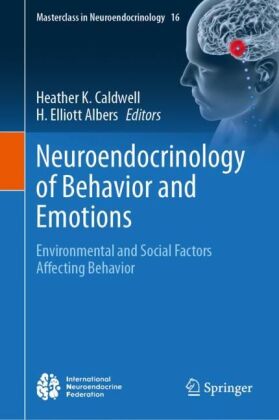
This volume highlights current research on how the neuroendocrine system helps to influence emotional states and ultimately behavioral output.
Social relationships and context-appropriate behavioral responses are important for the survival of most vertebrate species. These relationships can range from transient social interactions to strong social bonding between sexual partners and social behaviors can be observed and evaluated from the individual- to the group-level. Further, behavioral output is shaped by complex interactions between the physical environment, genetics, experience, and context, and are often modulated by the neuroendocrine system.
In this book, experts in the field will provide a sweeping look at novel research in the neuroendocrine regulation of important behaviors ranging from parental care to social homeostasis, with a focus on comparative studies across vertebrate species. The first part of the book is dedicated to theneuroendocrinology of relationships, including the coordination of acoustic signals in songbirds, the complexity of social relationships in primates, and cooperation and parenting in humans. The second part of the book focuses on social behaviors and provides some insights into their regulation, including the neuroendocrine regulation of maternal behavior in rodents, the roles of oxytocin and vasopressin in the modulation of sex-specific social behavior, the interactions between adult neurogenesis, the neuroendocrine system and social behavior, and a consideration of neuroendocrine influences on reproductive decision making across species. The book concludes with a section on environmental influences on neuroendocrine systems underlying behavior, including how social isolation and endocrine disrupting chemicals affect the neuroendocrinology of behavior and emotions.
Given its breadth, this volume is appropriate for undergraduate students, graduate students, postdoctoral researchers, and established researchers who are interested in neuroendocrinology and behavior.
This is the sixteenth volume in the International Neuroendocrine Federation (INF) Masterclass in Neuroendocrinology series, which aims to illustrate the highest standards and highlight the latest technologies in basic and clinical research and aspires to provide inspiration for further exploration into the exciting field of neuroendocrinology.