






Diese Website verwendet Cookies und ähnliche Technologien. Dabei handelt es sich um kleine Textdateien, die auf eurem Computer gespeichert und ausgelesen werden. Indem ihr auf "Alles akzeptieren" klickt, stimmt ihr der Verarbeitung von Daten, der Erstellung und Verarbeitung von individuellen Nutzungsprofilen über Websites und über Partner und Geräte hinweg sowie der Übermittlung eurer Daten an Drittanbieter zu, die eure Daten teilweise in Ländern außerhalb der Europäischen Union verarbeiten (GDPR Art. 49). Einzelheiten hierzu findet ihr in den Datenschutzhinweisen. Die Daten werden für Analysen und für eigene Zwecke Dritter verwendet. Weitere Informationen, auch über die Datenverarbeitung durch Drittanbieter und die Möglichkeit des Widerrufs, findet ihr in den Einstellungen und in unseren Datenschutzhinweisen. Hier könnt ihr mit den notwendigen Tools fortfahren.
- Verlag: Springer, Berlin
- Autor: Ram Narayan Yadava
- Artikel-Nr.: KNV97045923
- ISBN: 9783031508479
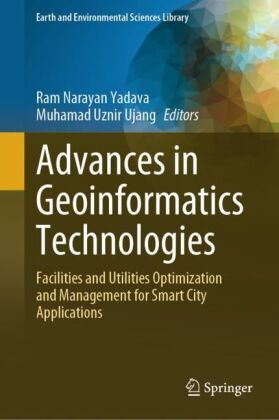
There are many GIS products for smart cities to implement smart city projects or activities. Most of the Geoinformatics Technologies and its application books are theoretical and lack of examples with real world data and step by step explanations to understand the facilities and utilities optimization and management for smart city applications and socio-economic aspects.
This book focuses and discusses topics related to how technological advances in Geoinformatics can help in the management operations of smart city applications to help our environment to be smart. Specifically, the volume focuses on how these advancements can help optimize and manage facilities and utilities. This book focuses on geoinformation modelling, geo-smart city applications, geoinformation technology, information system and computer science, and geolocation and positioning as its five primary areas of discussion. Each of these primary subjects delves into the application that uses geoinformatics technology in greater depth. This covers the use of Geoinformatics technology in the prevention of crime, coastal erosion, carbon emission modelling, landslide modelling, urban farming, and various other applications linked to the field. This book's objective is to provide a comprehensive review of the accomplishments that geoinformatics has made in a number of different application areas for smart cities. It covers Geoinformation Technologies, Geoinformation Modelling, Information System and Computer Science, Geolocation & Positioning, and Geo-Smart City Applications.
The book will be useful to graduate students, university faculty, and researchers in Geoinformatics sciences/engineering and architecture and town planning. It will also be useful to entrepreneurs, professionals, and planners in policy and decision making at the local, state and national levels.