






Diese Website verwendet Cookies und ähnliche Technologien. Dabei handelt es sich um kleine Textdateien, die auf eurem Computer gespeichert und ausgelesen werden. Indem ihr auf "Alles akzeptieren" klickt, stimmt ihr der Verarbeitung von Daten, der Erstellung und Verarbeitung von individuellen Nutzungsprofilen über Websites und über Partner und Geräte hinweg sowie der Übermittlung eurer Daten an Drittanbieter zu, die eure Daten teilweise in Ländern außerhalb der Europäischen Union verarbeiten (GDPR Art. 49). Einzelheiten hierzu findet ihr in den Datenschutzhinweisen. Die Daten werden für Analysen und für eigene Zwecke Dritter verwendet. Weitere Informationen, auch über die Datenverarbeitung durch Drittanbieter und die Möglichkeit des Widerrufs, findet ihr in den Einstellungen und in unseren Datenschutzhinweisen. Hier könnt ihr mit den notwendigen Tools fortfahren.
- Verlag: Springer, Berlin
- Autor: Francis Martin
- Artikel-Nr.: KNV97045754
- ISBN: 9781071628737
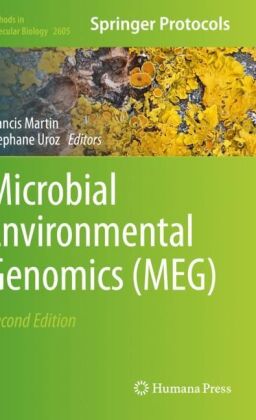
This volume guides researchers on how to characterize, image rare, and hitherto unknown taxa and their interactions, to identify new functions and biomolecules and to understand how environmental changes condition the activity and the response of the organisms living with us and in our environment.
Chapters cover different organism types (i.e., archaea, bacteria, fungi, protest, microfauna and microeukaryotes) and propose detailed protocols to produce high quality DNA, to analyse active microbial communities directly involved in complex interactions or processes through stable isotope probing, to identify and characterize of new functional genes, to image in situ interactions and to apply bioinformatics analysis tools to complex metagenomic or RNAseq sequence data. Written in the successful Methods in Molecular Biology series format, chapters include introductions to their respective topics, lists of the necessary materials and reagents, step-by-step, readily reproducible protocols, and notes on troubleshooting and avoiding known pitfalls.
Authoritative and cutting-edge, Microbial Environmental Genomics (MEG): Methods and Protocols, Second Edition aims to serve as a primary research reference for researchers in microbiology working to in the expanding field of molecular ecology and environmental genomics.