






Diese Website verwendet Cookies und ähnliche Technologien. Dabei handelt es sich um kleine Textdateien, die auf eurem Computer gespeichert und ausgelesen werden. Indem ihr auf "Alles akzeptieren" klickt, stimmt ihr der Verarbeitung von Daten, der Erstellung und Verarbeitung von individuellen Nutzungsprofilen über Websites und über Partner und Geräte hinweg sowie der Übermittlung eurer Daten an Drittanbieter zu, die eure Daten teilweise in Ländern außerhalb der Europäischen Union verarbeiten (GDPR Art. 49). Einzelheiten hierzu findet ihr in den Datenschutzhinweisen. Die Daten werden für Analysen und für eigene Zwecke Dritter verwendet. Weitere Informationen, auch über die Datenverarbeitung durch Drittanbieter und die Möglichkeit des Widerrufs, findet ihr in den Einstellungen und in unseren Datenschutzhinweisen. Hier könnt ihr mit den notwendigen Tools fortfahren.
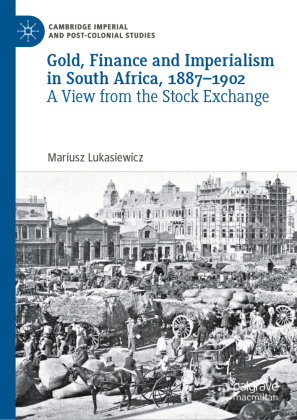
- Verlag: Springer, Berlin
- Autor: Mariusz Lukasiewicz
- Artikel-Nr.: KNV97071951
- ISBN: 9783031519468
This book provides a unique account of the financial and political history of the South African War by analysing the organisation and operations of the Johannesburg Stock Exchange (JSE), the oldest existing stock exchange in the African continent. Identifying the JSE as the nexus between international finance, South African gold mining and British imperialism, the book exposes the financial and political connections between Johannesburg, Pretoria, London, and Paris during the final stage of the imperial 'scramble for southern Africa.' Gold mining presented the South African Republic (ZAR) and the whole southern African regional economy with a long-term economic future and new prospects of industrialisation. However, this socio-economic transformation was dependent on extensive capital investments and the institutionalisation of a coercive labour regime based on racial discrimination. This monograph provides the first empirical examination of how international finance, imperial politics, and racialised industrial relations became entrenched in a key financial intermediary in colonial South Africa - first in Kimberley in the Cape Colony, and then in Johannesburg in the ZAR. By studying the Johannesburg capital market's social microstructures, the author demonstrates how colonial and international financial intermediaries underwrote and financed the largest wave of mining investments in Africa prior to the First World War. Filling an important gap in literature on nineteenth-century British imperialism and Anglo-African-Afrikaner relations, this insightful book uses the JSE as a lens to carefully expose the structures and agency of global finance in the outbreak of the South African War, and the making of South Africa as a unified colonial state.