






Diese Website verwendet Cookies und ähnliche Technologien. Dabei handelt es sich um kleine Textdateien, die auf eurem Computer gespeichert und ausgelesen werden. Indem ihr auf "Alles akzeptieren" klickt, stimmt ihr der Verarbeitung von Daten, der Erstellung und Verarbeitung von individuellen Nutzungsprofilen über Websites und über Partner und Geräte hinweg sowie der Übermittlung eurer Daten an Drittanbieter zu, die eure Daten teilweise in Ländern außerhalb der Europäischen Union verarbeiten (GDPR Art. 49). Einzelheiten hierzu findet ihr in den Datenschutzhinweisen. Die Daten werden für Analysen und für eigene Zwecke Dritter verwendet. Weitere Informationen, auch über die Datenverarbeitung durch Drittanbieter und die Möglichkeit des Widerrufs, findet ihr in den Einstellungen und in unseren Datenschutzhinweisen. Hier könnt ihr mit den notwendigen Tools fortfahren.
- Verlag: Penguin Books UK
- Autor: Robert Darnton
- Artikel-Nr.: KNV97393714
- ISBN: 9780141009964
A Sunday Times, Times Literary Supplement, and The Times Book of the Year
'Robert Darnton is one of the world's greatest historians, and this is an exceptional book: a huge social and cultural portrait of Paris in the build-up to the French Revolution' Dominic Sandbrook, Sunday Times, Books of the Year
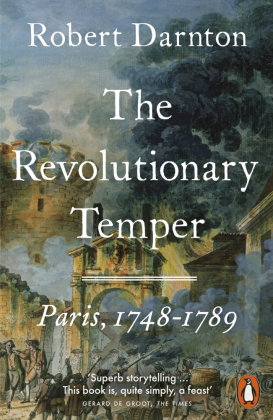
When a Parisian crowd stormed the Bastille in July 1789, it triggered an event of global consequence: the overthrow of the monarchy and the birth of a new society. Most historians account for the French Revolution by viewing it as the outcome of underlying conditions such as a faltering economy, class conflict or Enlightenment ideology. Without denying any of these, Robert Darnton offers a different explanation: what Parisians themselves, those at the centre of the Revolution, thought was happening at the time and how it guided their actions.
To understand the rise of what he calls 'the revolutionary temper', Darnton draws on a lifetime's study of pamphlets, books, underground newsletters, songs and public performances, exploring Paris as an information society not unlike our own. Its news circuits were centred in cafes and market-places, on park benches, and under the Palais-Royal's Tree of Cracow, a favourite gathering-place for gossips. He shows how the events of forty years - from disastrous treaties, official corruption and royal scandal to thrilling hot-air balloon ascents and a new conception of the nation - all entered the collective consciousness of ordinary Parisians. As news and opinion travelled across this profoundly unequal society, public trust in royal authority eroded, its legitimacy was undermined, and the social order unravelled.
Much of Robert Darnton's work has explained the hidden dynamics of history, never more so than in this exceptional book. It is a riveting narrative, but it adds a new dimension, the perceptions of contemporary Parisians, which allows us to see these momentous decades afresh.