






Diese Website verwendet Cookies und ähnliche Technologien. Dabei handelt es sich um kleine Textdateien, die auf eurem Computer gespeichert und ausgelesen werden. Indem ihr auf "Alles akzeptieren" klickt, stimmt ihr der Verarbeitung von Daten, der Erstellung und Verarbeitung von individuellen Nutzungsprofilen über Websites und über Partner und Geräte hinweg sowie der Übermittlung eurer Daten an Drittanbieter zu, die eure Daten teilweise in Ländern außerhalb der Europäischen Union verarbeiten (GDPR Art. 49). Einzelheiten hierzu findet ihr in den Datenschutzhinweisen. Die Daten werden für Analysen und für eigene Zwecke Dritter verwendet. Weitere Informationen, auch über die Datenverarbeitung durch Drittanbieter und die Möglichkeit des Widerrufs, findet ihr in den Einstellungen und in unseren Datenschutzhinweisen. Hier könnt ihr mit den notwendigen Tools fortfahren.
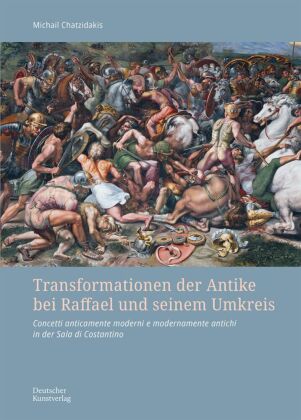
- Verlag: Deutscher Kunstverlag
- Autor: Michail Chatzidakis
- Artikel-Nr.: KNV97474312
- ISBN: 9783422801059
The murals of the Battle of the Milvian Bridge and the Vision of the Cross in the Sala di Costantino in the Vatican, named after the fresco-cycle conceived by Raphael and executed by Giulio Romano, are regarded by scholars as originating from an intense study of antiquity in Raphael's circle, followed by a desire to achieve an historically accurate approach to ancient art. However, Raphael was recognised already by Giorgio Vasari, Ludovico Dolce and Annibale Carracci, not only for his expertise on antiquity, but also for his poetic qualities as an outstanding history painter. Based on the motto anticamente moderno e modernamente antico, with which Pietro Aretino describes Giulio Romano's ideal synthesis of ancient and contemporary art, Michail Chatzidakis analyses the difference between historical and poetic methods of representation in order to determine more precisely the relationship between archaeological precision and poetic creativity in the work of Raphael and his circle in the Sala di Costantino.