






Diese Website verwendet Cookies und ähnliche Technologien. Dabei handelt es sich um kleine Textdateien, die auf eurem Computer gespeichert und ausgelesen werden. Indem ihr auf "Alles akzeptieren" klickt, stimmt ihr der Verarbeitung von Daten, der Erstellung und Verarbeitung von individuellen Nutzungsprofilen über Websites und über Partner und Geräte hinweg sowie der Übermittlung eurer Daten an Drittanbieter zu, die eure Daten teilweise in Ländern außerhalb der Europäischen Union verarbeiten (GDPR Art. 49). Einzelheiten hierzu findet ihr in den Datenschutzhinweisen. Die Daten werden für Analysen und für eigene Zwecke Dritter verwendet. Weitere Informationen, auch über die Datenverarbeitung durch Drittanbieter und die Möglichkeit des Widerrufs, findet ihr in den Einstellungen und in unseren Datenschutzhinweisen. Hier könnt ihr mit den notwendigen Tools fortfahren.
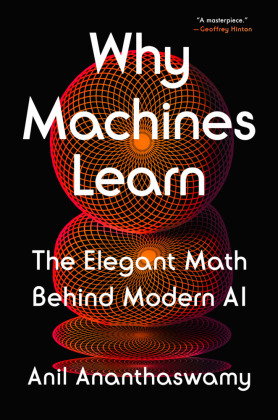
- Verlag: Penguin Random House
- Autor: Anil Ananthaswamy
- Artikel-Nr.: KNV97057674
- ISBN: 9780593185742
Machine learning systems are making life-altering decisions for us: approving mortgage loans, determining whether a tumor is cancerous, or deciding if someone gets bail. They now influence developments and discoveries in chemistry, biology, and physics the study of genomes, extrasolar planets, even the intricacies of quantum systems. And all this before large language models such as ChatGPT came on the scene.
We are living through a revolution in machine learning-powered AI that shows no signs of slowing down. This technology is based on relatively simple mathematical ideas, some of which go back centuries, including linear algebra and calculus, the stuff of seventeenth- and eighteenth-century mathematics. It took the birth and advancement of computer science and the kindling of 1990s computer chips designed for video games to ignite the explosion of AI that we see today. In this enlightening book, Anil Ananthaswamy explains the fundamental math behind machine learning, while suggesting intriguing links between artificial and natural intelligence. Might the same math underpin them both?
As Ananthaswamy resonantly concludes, to make safe and effective use of artificial intelligence, we need to understand its profound capabilities and limitations, the clues to which lie in the math that makes machine learning possible.