






Diese Website verwendet Cookies und ähnliche Technologien. Dabei handelt es sich um kleine Textdateien, die auf eurem Computer gespeichert und ausgelesen werden. Indem ihr auf "Alles akzeptieren" klickt, stimmt ihr der Verarbeitung von Daten, der Erstellung und Verarbeitung von individuellen Nutzungsprofilen über Websites und über Partner und Geräte hinweg sowie der Übermittlung eurer Daten an Drittanbieter zu, die eure Daten teilweise in Ländern außerhalb der Europäischen Union verarbeiten (GDPR Art. 49). Einzelheiten hierzu findet ihr in den Datenschutzhinweisen. Die Daten werden für Analysen und für eigene Zwecke Dritter verwendet. Weitere Informationen, auch über die Datenverarbeitung durch Drittanbieter und die Möglichkeit des Widerrufs, findet ihr in den Einstellungen und in unseren Datenschutzhinweisen. Hier könnt ihr mit den notwendigen Tools fortfahren.
- Verlag: Springer, Berlin
- Autor: Mark S. Courey
- Artikel-Nr.: KNV97554757
- ISBN: 9783031246340
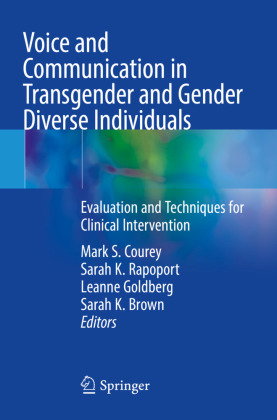
This book serves as a guide to any patient, clinician, or person who desires to understand how transgender and gender diverse individuals can be assisted in achieving voice and communication congruity with gender. Voice and communication style serve as intricate links to one's identity and are central aspects of the gender transition process. Guiding a transgender or gender diverse patient through this transition is complex, requiring an understanding of the patient's desires, the ability to identify and work with patients to achieve sustainable patterns of behavioral modification that affect voice in a positive manner, and an understanding of the role of newly emerging surgical techniques. This is best addressed by an interdisciplinary team, and this book makes this material available in one source.
The first section of the book consists of introductory chapters written by primary care physicians, endocrinologists, and psychiatrists addressing the complex nature of transition from the medical standpoint. A review of hormonal replacement therapies, psychological evaluations, and potential effects of hormone replacement on voice is included. The second section describes the behavioral techniques available in speech and voice therapy for voice change and addresses outcomes that can be expected from behavioral intervention. Each chapter addresses the physiologic principles of therapeutic techniques for effecting change, techniques of instruction, nuances for transgender and gender diverse patients, methods of generalization, and methods of maintenance. Finally, the third section of the book details the surgical techniques available to assist patients in voice transition and their expected outcomes for voice modification. Each chapter includes an introduction, preoperative assessment, role of preoperative therapy, surgical technique, postoperative management, and expected outcome. This section also includes a surgical atlas.
This is an ideal guide forotolaryngologists, speech-language pathologists, primary care providers, as well as psychiatrists and endocrinologists caring for transgender and gender nonconforming patients.