






Diese Website verwendet Cookies und ähnliche Technologien. Dabei handelt es sich um kleine Textdateien, die auf eurem Computer gespeichert und ausgelesen werden. Indem ihr auf "Alles akzeptieren" klickt, stimmt ihr der Verarbeitung von Daten, der Erstellung und Verarbeitung von individuellen Nutzungsprofilen über Websites und über Partner und Geräte hinweg sowie der Übermittlung eurer Daten an Drittanbieter zu, die eure Daten teilweise in Ländern außerhalb der Europäischen Union verarbeiten (GDPR Art. 49). Einzelheiten hierzu findet ihr in den Datenschutzhinweisen. Die Daten werden für Analysen und für eigene Zwecke Dritter verwendet. Weitere Informationen, auch über die Datenverarbeitung durch Drittanbieter und die Möglichkeit des Widerrufs, findet ihr in den Einstellungen und in unseren Datenschutzhinweisen. Hier könnt ihr mit den notwendigen Tools fortfahren.
- Verlag: Springer, Berlin
- Autor: Tim Surma
- Artikel-Nr.: KNV97627263
- ISBN: 9783031746604
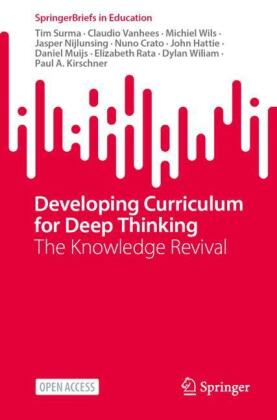
This open access book discusses why the seemingly straightforward strategy of teaching children how to think deeply does not work and offers an alternative way forward for the curriculum to achieve these objectives. Over the years, the role of knowledge in the curriculum has, like a pendulum, shifted between two extremes, from highly visible to virtually invisible knowledge elements. Insights from cognitive and educational psychology, sociology, and curriculum studies are used to underpin the current knowledge revival that is widely being observed in education. A knowledge-rich curriculum is proposed by the authors as not only the soundest way forward to both effectively acquire knowledge and complex cognitive skills in school, but also as a crucial lever to achieve equitable opportunities for all students. In understanding how a knowledge-rich curriculum can enhance learning, three overarching principles are discussed: (1) content-richness, (2) coherence, and (3) clarity. These principles are illustrated through practical examples from schools and educators who have effectively integrated knowledge-rich curricula.