






Diese Website verwendet Cookies und ähnliche Technologien. Dabei handelt es sich um kleine Textdateien, die auf eurem Computer gespeichert und ausgelesen werden. Indem ihr auf "Alles akzeptieren" klickt, stimmt ihr der Verarbeitung von Daten, der Erstellung und Verarbeitung von individuellen Nutzungsprofilen über Websites und über Partner und Geräte hinweg sowie der Übermittlung eurer Daten an Drittanbieter zu, die eure Daten teilweise in Ländern außerhalb der Europäischen Union verarbeiten (GDPR Art. 49). Einzelheiten hierzu findet ihr in den Datenschutzhinweisen. Die Daten werden für Analysen und für eigene Zwecke Dritter verwendet. Weitere Informationen, auch über die Datenverarbeitung durch Drittanbieter und die Möglichkeit des Widerrufs, findet ihr in den Einstellungen und in unseren Datenschutzhinweisen. Hier könnt ihr mit den notwendigen Tools fortfahren.
- Verlag: Taylor & Francis
- Autor: Alberto Gabriele
- Artikel-Nr.: KNV97611817
- ISBN: 9781032212227
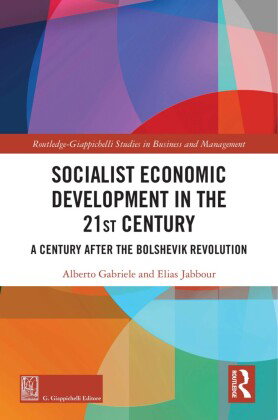
Over a hundred years after the first socialist revolution broke the global monopoly of capitalism, a new class of socialist-oriented socioeconomic development is coming to the fore. Capitalism is still dominant worldwide, although its hegemony is no longer undisputed, and humankind is now faced with a key existential challenge. This book proposes an alternative path to overcoming the worldwide crisis of globalized capitalism. It offers a novel, balanced and historically rooted interpretation of the successes and failures of socialist economic construction throughout the last century.
The authors apply a multidisciplinary, holistic and purpose-based methodology to draw basic lessons from stylized facts, emerging in different areas of knowledge, ranging from political economy to biology, and from key national socioeconomic experiences, with a particular focus on China. The book is divided into three parts. The first is mainly theoretical and general in nature, identifying the major contributions bequeathed by the hard sciences to their social counterparts. Consistent with these findings, the authors offer a stylized interpretation of the contemporary state-of-the-art of the debate on the core concepts of economic science and advance a few elementary theories about what socialism in the 21st century could look like. The second and third parts analyze and discusses the core features of a few select experiences, which have evolved in certain countries since 1917, some of which are still unfolding.
The book will find an audience among academics, researchers and students in the fields of economics, political science, history, and geography, as well as, policy makers, particularly in developing countries.