






Diese Website verwendet Cookies und ähnliche Technologien. Dabei handelt es sich um kleine Textdateien, die auf eurem Computer gespeichert und ausgelesen werden. Indem ihr auf "Alles akzeptieren" klickt, stimmt ihr der Verarbeitung von Daten, der Erstellung und Verarbeitung von individuellen Nutzungsprofilen über Websites und über Partner und Geräte hinweg sowie der Übermittlung eurer Daten an Drittanbieter zu, die eure Daten teilweise in Ländern außerhalb der Europäischen Union verarbeiten (GDPR Art. 49). Einzelheiten hierzu findet ihr in den Datenschutzhinweisen. Die Daten werden für Analysen und für eigene Zwecke Dritter verwendet. Weitere Informationen, auch über die Datenverarbeitung durch Drittanbieter und die Möglichkeit des Widerrufs, findet ihr in den Einstellungen und in unseren Datenschutzhinweisen. Hier könnt ihr mit den notwendigen Tools fortfahren.
- Verlag: Taylor & Francis
- Autor: Elishai Ezra Tsur
- Artikel-Nr.: KNV97605799
- ISBN: 9780367698386
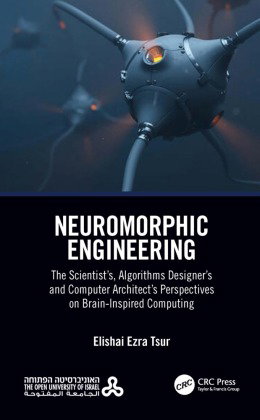
The brain is not a glorified digital computer. It does not store information in registers, and it does not mathematically transform mental representations to establish perception or behavior. The brain cannot be downloaded to a computer to provide immortality, nor can it destroy the world by having its emerged consciousness traveling in cyberspace. However, studying the brain's core computation architecture can inspire scientists, computer architects, and algorithm designers to think fundamentally differently about their craft.
Neuromorphic engineers have the ultimate goal of realizing machines with some aspects of cognitive intelligence. They aspire to design computing architectures that could surpass existing digital von Neumann-based computing architectures' performance. In that sense, brain research bears the promise of a new computing paradigm. As part of a complete cognitive hardware and software ecosystem, neuromorphic engineering opens new frontiers for neuro-robotics, artificial intelligence, and supercomputing applications.
The book presents neuromorphic engineering from three perspectives: the scientist, the computer architect, and the algorithm designer. It zooms in and out of the different disciplines, allowing readers with diverse backgrounds to understand and appreciate the field. Overall, the book covers the basics of neuronal modeling, neuromorphic circuits, neural architectures, event-based communication, and the neural engineering framework.