






Diese Website verwendet Cookies und ähnliche Technologien. Dabei handelt es sich um kleine Textdateien, die auf eurem Computer gespeichert und ausgelesen werden. Indem ihr auf "Alles akzeptieren" klickt, stimmt ihr der Verarbeitung von Daten, der Erstellung und Verarbeitung von individuellen Nutzungsprofilen über Websites und über Partner und Geräte hinweg sowie der Übermittlung eurer Daten an Drittanbieter zu, die eure Daten teilweise in Ländern außerhalb der Europäischen Union verarbeiten (GDPR Art. 49). Einzelheiten hierzu findet ihr in den Datenschutzhinweisen. Die Daten werden für Analysen und für eigene Zwecke Dritter verwendet. Weitere Informationen, auch über die Datenverarbeitung durch Drittanbieter und die Möglichkeit des Widerrufs, findet ihr in den Einstellungen und in unseren Datenschutzhinweisen. Hier könnt ihr mit den notwendigen Tools fortfahren.
- Verlag: Springer, Berlin
- Autor: Arkadii Slinko
- Artikel-Nr.: KNV97789998
- ISBN: 9783031826252
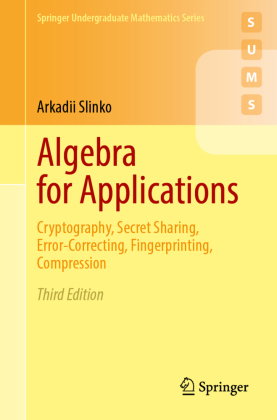
This textbook provides mathematical tools and applies them to study key aspects of data transmission such as encryption and compression. Modern societies are awash with data that needs to be manipulated in many ways: encrypted, compressed, shared between users in a prescribed manner, protected from unauthorized access, and transmitted over unreliable channels. All of these operations are based on algebra and number theory. This textbook covers background topics in arithmetic, polynomials, groups, fields, and elliptic curves required for real-life applications like cryptography, secret sharing, error-correcting, fingerprinting, and compression of information.
The book illustrates the work of these applications using the free GAP computational package. It uses this package to help readers understand computationally hard problems and provide insights into protecting data integrity. This textbook covers a wide range of applications including recent developments, primarily intended for use as a textbook, with numerous worked examples and solved exercises suitable for self-study.
This edition has been thoroughly revised with new topics and exercises, introducing hash functions for properly describing digital signatures, blockchains, and digital currencies in the latest version.