






Diese Website verwendet Cookies und ähnliche Technologien. Dabei handelt es sich um kleine Textdateien, die auf eurem Computer gespeichert und ausgelesen werden. Indem ihr auf "Alles akzeptieren" klickt, stimmt ihr der Verarbeitung von Daten, der Erstellung und Verarbeitung von individuellen Nutzungsprofilen über Websites und über Partner und Geräte hinweg sowie der Übermittlung eurer Daten an Drittanbieter zu, die eure Daten teilweise in Ländern außerhalb der Europäischen Union verarbeiten (GDPR Art. 49). Einzelheiten hierzu findet ihr in den Datenschutzhinweisen. Die Daten werden für Analysen und für eigene Zwecke Dritter verwendet. Weitere Informationen, auch über die Datenverarbeitung durch Drittanbieter und die Möglichkeit des Widerrufs, findet ihr in den Einstellungen und in unseren Datenschutzhinweisen. Hier könnt ihr mit den notwendigen Tools fortfahren.
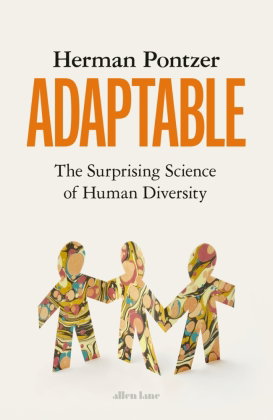
- Verlag: Penguin Books UK
- Autor: Herman Pontzer
- Artikel-Nr.: KNV97809032
- ISBN: 9780241561614
'Engrossing, richly informative . . . challenges us to rethink universal health benchmarks' New Yorker
A new way of thinking about diversity and what really unites us, from the internationally renowned author of Burn
Real diversity isn't skin deep. Over the past 100,000 years, as humans expanded into every biome on the planet, our bodies and our cultures have been fine-tuned to our local environments. Beyond the physical demands of our climate, we live our lives immersed in ideas and norms that affect what we eat, how we move and why we get sick - all of which, in turn, affect how our bodies work.
As an evolutionary anthropologist conducting ground-breaking research with human populations around the globe, Herman Pontzer has come to see much more clearly how our genes and environments combine to shape our bodies and our health: for better or worse. In this book, he takes us on a tour of the human body and the surprising ways it can change in response to its environment: from the Andean groups who have developed increased lung capacity to the Sama divers who have larger spleens. He also highlights the critical ways we misinterpret biological adaptations: in healthcare, public policy and individual choices.
With so much of our wellbeing and public discourse centred on human biology, a clear understanding of the distinction between socially constructed and genetic differences is more important than ever. This timely reappraisal of an overlooked science is an essential guide to our remarkable bodies.