






Diese Website verwendet Cookies und ähnliche Technologien. Dabei handelt es sich um kleine Textdateien, die auf eurem Computer gespeichert und ausgelesen werden. Indem ihr auf "Alles akzeptieren" klickt, stimmt ihr der Verarbeitung von Daten, der Erstellung und Verarbeitung von individuellen Nutzungsprofilen über Websites und über Partner und Geräte hinweg sowie der Übermittlung eurer Daten an Drittanbieter zu, die eure Daten teilweise in Ländern außerhalb der Europäischen Union verarbeiten (GDPR Art. 49). Einzelheiten hierzu findet ihr in den Datenschutzhinweisen. Die Daten werden für Analysen und für eigene Zwecke Dritter verwendet. Weitere Informationen, auch über die Datenverarbeitung durch Drittanbieter und die Möglichkeit des Widerrufs, findet ihr in den Einstellungen und in unseren Datenschutzhinweisen. Hier könnt ihr mit den notwendigen Tools fortfahren.
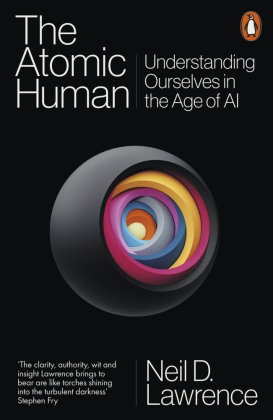
- Verlag: Penguin Books UK
- Autor: Neil D. Lawrence
- Artikel-Nr.: KNV97808992
- ISBN: 9781802062106
'An utterly absorbing account of humans, computers, and how much they differ' Dame Diane Coyle, author of Cogs and Monsters
What does Artificial Intelligence mean for our identity? Our fascination with AI stems from the perceived uniqueness of human intelligence. We believe it's what differentiates us. Fears of AI not only concern how it invades our digital lives, but also the implied threat of an intelligence that displaces us from our position at the centre of the world.
Neil D. Lawrence's visionary book shows why these fears may be misplaced. Atomism, proposed by Democritus, suggested it was impossible to continue dividing matter down into ever smaller components: eventually we reach a point where a cut cannot be made (the Greek for uncuttable is 'atom'). In the same way, by slicing away at the facets of human intelligence that can be replaced by machines, AI uncovers what is left: an indivisible core that is the essence of humanity.
Human intelligence has evolved across hundreds of thousands of years. Due to our physical and cognitive constraints over that time, it is social and highly embodied. By contrasting our capabilities with machine intelligence, The Atomic Human reveals the technical origins, capabilities and limitations of AI systems, and how they should be wielded. Not just by the experts, but ordinary people. Understanding this will enable readers to choose the future we want - either one where AI is a tool for us, or where we become a tool of AI - and how to counteract the digital oligarchy to maintain the fabric of an open, fair and democratic society.