






Diese Website verwendet Cookies und ähnliche Technologien. Dabei handelt es sich um kleine Textdateien, die auf eurem Computer gespeichert und ausgelesen werden. Indem ihr auf "Alles akzeptieren" klickt, stimmt ihr der Verarbeitung von Daten, der Erstellung und Verarbeitung von individuellen Nutzungsprofilen über Websites und über Partner und Geräte hinweg sowie der Übermittlung eurer Daten an Drittanbieter zu, die eure Daten teilweise in Ländern außerhalb der Europäischen Union verarbeiten (GDPR Art. 49). Einzelheiten hierzu findet ihr in den Datenschutzhinweisen. Die Daten werden für Analysen und für eigene Zwecke Dritter verwendet. Weitere Informationen, auch über die Datenverarbeitung durch Drittanbieter und die Möglichkeit des Widerrufs, findet ihr in den Einstellungen und in unseren Datenschutzhinweisen. Hier könnt ihr mit den notwendigen Tools fortfahren.
- Verlag: Taylor & Francis
- Autor: Edwin S. Dalmaijer
- Artikel-Nr.: KNV97838270
- ISBN: 9781032000459
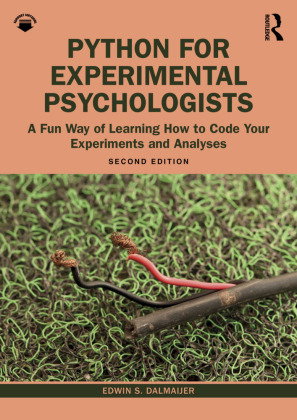
Python for Experimental Psychologists equips researchers who have no prior programming experience with the essential knowledge to independently script experiments and analyses in the programming language Python. This book offers an excellent introduction, whether you are an undergraduate, a PhD candidate, or an established researcher.
This updated edition is on Python 3 (the most current version). It starts by teaching the fundamentals of programming in Python and then offers several chapters on scripting experiments (displaying stimuli, obtaining and logging user input, precision timing, etc.) using the popular PsychoPy package. The remainder of the book is dedicated to data analysis and includes chapters on reading/writing to text files, time series, eye tracking, data visualisation, and statistics.
Access to online support material enriches the learning experience with colour figures, example stimuli, datasets, scripts, and a portable Windows installation of Python. This book assumes no prior knowledge, and its informal and accessible tone helps readers with backgrounds in experimental psychology and cognitive neuroscience to quickly understand Python. It serves as a useful resource not only for researchers in these fields but also for lecturers instructing on methodology and data analysis.
Python for Experimental Psychologists demystifies programming complexities and empowers researchers to proficiently conduct experiments and analyse their results.