


Diese Website verwendet Cookies und ähnliche Technologien. Dabei handelt es sich um kleine Textdateien, die auf eurem Computer gespeichert und ausgelesen werden. Indem ihr auf "Alles akzeptieren" klickt, stimmt ihr der Verarbeitung von Daten, der Erstellung und Verarbeitung von individuellen Nutzungsprofilen über Websites und über Partner und Geräte hinweg sowie der Übermittlung eurer Daten an Drittanbieter zu, die eure Daten teilweise in Ländern außerhalb der Europäischen Union verarbeiten (GDPR Art. 49). Einzelheiten hierzu findet ihr in den Datenschutzhinweisen. Die Daten werden für Analysen und für eigene Zwecke Dritter verwendet. Weitere Informationen, auch über die Datenverarbeitung durch Drittanbieter und die Möglichkeit des Widerrufs, findet ihr in den Einstellungen und in unseren Datenschutzhinweisen. Hier könnt ihr mit den notwendigen Tools fortfahren.
- Verlag: De Gruyter
- Autor: David B. Ruderman
- Artikel-Nr.: KNV97842012
- ISBN: 9783110336931
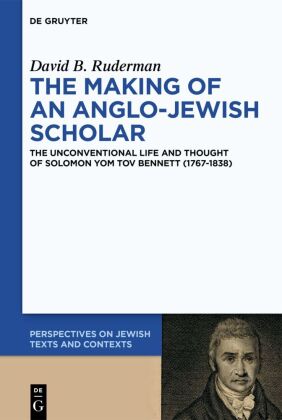
This book is a study of the life and thought of the Polish Jew Solomon Yom Tov Bennett (1767-1838), who immigrated to London where he spent the last forty years of his life. In focusing on Bennett's learned life, it underscores the significance of this singular writer, artist, and public figure, especially his remarkable dual interests in art and thought, his biblical scholarship, his social and intellectual connections with some of the most famous and accomplished Christian intellectuals of London, and his self-determination to complete his life-long ambition of serving Western civilization by correcting and rewriting the entire standard edition of the English Old Testament.
Bennett's Christian associates respected his learning and were willing to accept him as a Jew in their ranks. His integration into the upper echelons of the Christian literary establishment-dukes, jurists, theologians, and other scholars-did not impede his loyalty to his faith. On the contrary, Bennett's Christian friends made him more Jewish, more convinced of Judaism's moral force, and more secure in his own skin as a member of a proud minority among Christian elites supposedly liberated, so he hoped, from the dark hostility of the Christian past. His supreme act of translating the Bible constituted the ultimate payback he could offer the altruistic Christians he had met, open to welcoming him not despite his Jewishness but because of it. Bennett's transformation from a Polish Jewish immigrant to a proud Anglo-Jew exemplifies a unique path of modern Jewish life and self-reflection, one ultimately shaped by the particular ambiance of his newly adopted country.