






Diese Website verwendet Cookies und ähnliche Technologien. Dabei handelt es sich um kleine Textdateien, die auf eurem Computer gespeichert und ausgelesen werden. Indem ihr auf "Alles akzeptieren" klickt, stimmt ihr der Verarbeitung von Daten, der Erstellung und Verarbeitung von individuellen Nutzungsprofilen über Websites und über Partner und Geräte hinweg sowie der Übermittlung eurer Daten an Drittanbieter zu, die eure Daten teilweise in Ländern außerhalb der Europäischen Union verarbeiten (GDPR Art. 49). Einzelheiten hierzu findet ihr in den Datenschutzhinweisen. Die Daten werden für Analysen und für eigene Zwecke Dritter verwendet. Weitere Informationen, auch über die Datenverarbeitung durch Drittanbieter und die Möglichkeit des Widerrufs, findet ihr in den Einstellungen und in unseren Datenschutzhinweisen. Hier könnt ihr mit den notwendigen Tools fortfahren.
- Verlag: Springer, Berlin
- Autor: Willy Christian Kriz
- Artikel-Nr.: KNV97870073
- ISBN: 9789819643240
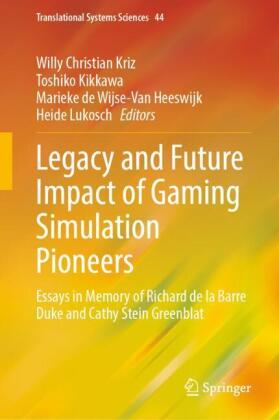
This book is a tribute to two pioneers in the field of gaming simulation: Richard de la Barre Duke and Cathy Stein Greenblat. Duke was a professor of urban planning at the University of Michigan who introduced gaming simulation into urban planning and policy making in the early 1970s. With his 1974 book Gaming: The future s language, he proposed simulation games as a multilogue language for bringing different disciplines and stakeholders perspectives together. He was co-founder of the International Simulation and Gaming Association (ISAGA). Cathy Stein Greenblat was a professor of sociology at Rutgers University, using gaming simulation education and health care beginning in the mid-1970s. She was editor in chief of the international journal Simulation & Gaming for many years. Duke and Greenblat worked together and authored several influential books, and both were honorary members of ISAGA until they passed away in 2022.
The present book focuses on the past and actual scientific and practical impact of their work for design and development, facilitation and debriefing, evaluation, and research of simulation games. The book contains discussions and case examples of how their key concepts are still used and can be used in the future to have a social impact through gaming simulation. Furthermore, the book shows how their work and guiding simulation game design principles continue to inspire ongoing and future research in the context of dealing with complexity and to support social and environmental transition through gaming simulation- Included are interviews with the two pioneers and contributions of other outstanding experts about their work.