






Diese Website verwendet Cookies und ähnliche Technologien. Dabei handelt es sich um kleine Textdateien, die auf eurem Computer gespeichert und ausgelesen werden. Indem ihr auf "Alles akzeptieren" klickt, stimmt ihr der Verarbeitung von Daten, der Erstellung und Verarbeitung von individuellen Nutzungsprofilen über Websites und über Partner und Geräte hinweg sowie der Übermittlung eurer Daten an Drittanbieter zu, die eure Daten teilweise in Ländern außerhalb der Europäischen Union verarbeiten (GDPR Art. 49). Einzelheiten hierzu findet ihr in den Datenschutzhinweisen. Die Daten werden für Analysen und für eigene Zwecke Dritter verwendet. Weitere Informationen, auch über die Datenverarbeitung durch Drittanbieter und die Möglichkeit des Widerrufs, findet ihr in den Einstellungen und in unseren Datenschutzhinweisen. Hier könnt ihr mit den notwendigen Tools fortfahren.
- Verlag: Springer, Berlin
- Autor: Abdalmuttaleb M. A. Musleh Al-Sartawi
- Artikel-Nr.: KNV97881001
- ISBN: 9783031875830
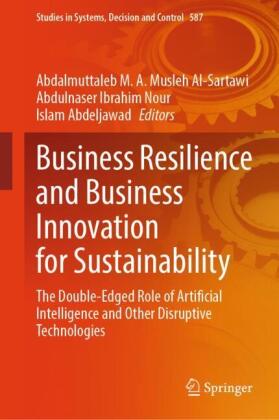
This book is timely as it explores the double-edged nature of disruptive technologies in providing both challenges and opportunities for businesses in the age of digital transformation. Business resilience has two major forms related to timescales. Both kinds of resilience are identified as key for delivering sustainable development. The opposite is also found to be true. Both are needed to deliver either and to let businesses survive and grow. Sustainability is increasingly a strategic issue for firms seeking sustainable competitive advantage. It has been driven by stakeholder, legislative, and cost changes, including natural resource constraints (Frizzo-Barker et al. 2020). Business resilience has also been of interest recently due to the unpredictable effects of globalization and economic turbulence and in response to changing social limitations on, and expectations of, companies.
The topic of sustainable development has become ubiquitous in the last 30 years (Henderson and Loreau, 2023), yet how to achieve such a goal, or whether it is even possible, remains a major unknown. This book attempts to provide a platform for researchers and practitioners to discuss sustainability in light of the eruption of disruptive technologies, legislations, regulations, and stakeholder demands. This book s purpose is twofold: it aims to explore artificial intelligence and digital transformation implications for achieving business resilience and business innovation. Second, it aims to cover unique and variety of interdisciplinary topics in the challenges and opportunities of disruptive technologies and how these advanced technologies can be implemented to contribute toward sustainable development goals and sustainability.
Consequently, to address the aims of the book, it seeks exploratory, empirical, interpretive, and theoretical research built on either primary or secondary data. The approaches suggested are not exhaustive and can be extended upon by the researchers. In addition, the book contributes toward the UN s sustainable development goals.