






Diese Website verwendet Cookies und ähnliche Technologien. Dabei handelt es sich um kleine Textdateien, die auf eurem Computer gespeichert und ausgelesen werden. Indem ihr auf "Alles akzeptieren" klickt, stimmt ihr der Verarbeitung von Daten, der Erstellung und Verarbeitung von individuellen Nutzungsprofilen über Websites und über Partner und Geräte hinweg sowie der Übermittlung eurer Daten an Drittanbieter zu, die eure Daten teilweise in Ländern außerhalb der Europäischen Union verarbeiten (GDPR Art. 49). Einzelheiten hierzu findet ihr in den Datenschutzhinweisen. Die Daten werden für Analysen und für eigene Zwecke Dritter verwendet. Weitere Informationen, auch über die Datenverarbeitung durch Drittanbieter und die Möglichkeit des Widerrufs, findet ihr in den Einstellungen und in unseren Datenschutzhinweisen. Hier könnt ihr mit den notwendigen Tools fortfahren.
- Verlag: Springer, Berlin
- Autor: Biplav Srivastava
- Artikel-Nr.: KNV97925496
- ISBN: 9783031898525
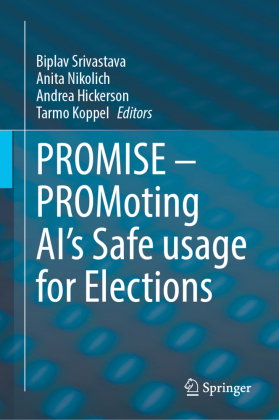
This book explores the evolving role of artificial intelligence in electoral processes, focusing on its potential to improve data-driven decision-making amid the growing challenges of misinformation, manipulation, and voter suppression. It discusses how AI tools from chatbots to comprehensive data systems could address information gaps for voters, candidates, and election commissions, especially during a pivotal election year like 2024, while acknowledging the skepticism and fears that often surround the use of AI in such critical civic functions.
Drawing on insights from three specialized workshops at major AI conferences, the book compiles research and expert discussions from fields such as security, journalism, law, and political science. It serves as a comprehensive resource for researchers, educators, practitioners, students, and government officials, offering self-contained chapters that cover both technical and ethical aspects of employing AI in elections. The work also emphasizes the importance of maintaining high professional and ethical standards in the intersection of technology and democracy.
This book will serve as an important resource on election topics, AI techniques and trust methods for researchers, teachers, practitioners, students and government officials in their efforts to improve democratic electoral processes with technology. It assumes the reader is knowledgeable, at high school level or higher, about one or more topics in civics and computing concepts. Sufficient background are given by contributors to make the chapters self-contained and widely understandable.