






Diese Website verwendet Cookies und ähnliche Technologien. Dabei handelt es sich um kleine Textdateien, die auf eurem Computer gespeichert und ausgelesen werden. Indem ihr auf "Alles akzeptieren" klickt, stimmt ihr der Verarbeitung von Daten, der Erstellung und Verarbeitung von individuellen Nutzungsprofilen über Websites und über Partner und Geräte hinweg sowie der Übermittlung eurer Daten an Drittanbieter zu, die eure Daten teilweise in Ländern außerhalb der Europäischen Union verarbeiten (GDPR Art. 49). Einzelheiten hierzu findet ihr in den Datenschutzhinweisen. Die Daten werden für Analysen und für eigene Zwecke Dritter verwendet. Weitere Informationen, auch über die Datenverarbeitung durch Drittanbieter und die Möglichkeit des Widerrufs, findet ihr in den Einstellungen und in unseren Datenschutzhinweisen. Hier könnt ihr mit den notwendigen Tools fortfahren.
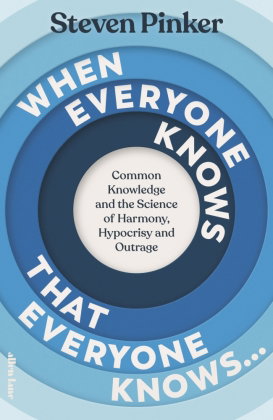
- Verlag: Penguin Books UK
- Autor: Steven Pinker
- Artikel-Nr.: KNV97938973
- ISBN: 9780241618837
'One of the most insightful books I've read about what makes us human and how we understand each other' Bill Gates
Steven Pinker, one of the world's greatest thinkers and bestselling author of Enlightenment Now, The Better Angels of Our Nature and The Language Instinct, reveals the power and perils of thinking alike
As a cognitive scientist, the ultimate subject of Steven Pinker's fascination is how we think about each other's thoughts, ad infinitum. It sounds impossible, but Steven Pinker shows that we do it all the time. This awareness, which we experience as something that is public or "out there," is called common knowledge, and it has a momentous impact on our social, political, and economic lives.
Common knowledge, Pinker shows, can make sense of many of life's enigmas: financial bubbles and crashes, revolutions that come out of nowhere, the posturing and pretence of diplomacy, the eruption of social media shaming mobs and academic cancel culture, the awkwardness of a first date. But people also go to great lengths to avoid common knowledge-to ensure that even if everyone knows something, they can't know that everyone else knows they know it. And so we get rituals like benign hypocrisy, veiled bribes and threats, sexual innuendo, and pretending not to see the elephant in the room.
In exploring the paradoxes of human behaviour, When Everyone Knows that Everyone Knows... invites us to understand the ways we try to get into each other's heads, and the harmonies, hypocrisies, and outrages that result.