






Diese Website verwendet Cookies und ähnliche Technologien. Dabei handelt es sich um kleine Textdateien, die auf eurem Computer gespeichert und ausgelesen werden. Indem ihr auf "Alles akzeptieren" klickt, stimmt ihr der Verarbeitung von Daten, der Erstellung und Verarbeitung von individuellen Nutzungsprofilen über Websites und über Partner und Geräte hinweg sowie der Übermittlung eurer Daten an Drittanbieter zu, die eure Daten teilweise in Ländern außerhalb der Europäischen Union verarbeiten (GDPR Art. 49). Einzelheiten hierzu findet ihr in den Datenschutzhinweisen. Die Daten werden für Analysen und für eigene Zwecke Dritter verwendet. Weitere Informationen, auch über die Datenverarbeitung durch Drittanbieter und die Möglichkeit des Widerrufs, findet ihr in den Einstellungen und in unseren Datenschutzhinweisen. Hier könnt ihr mit den notwendigen Tools fortfahren.
- Verlag: Springer, Berlin
- Autor: Jan-Philipp Küppers
- Artikel-Nr.: KNV97943550
- ISBN: 9783658481216
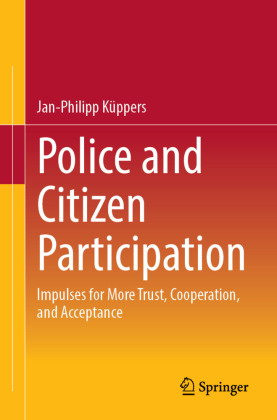
This book explains why participation processes have gained importance for the police and how they can be successfully designed. In the future, an integrated security structure will increasingly be required, in which stakeholder groups and affected citizens play an important role in police hazard and risk assessment, and thus in shaping their context-related sense of security. The book pursues a guiding and action-oriented approach on how practical participation processes for citizens can be integrated into the planning and projects of the police. Theoretical foundations and practical application fields for the implementation of participation processes are identified: involvement in cooperation discussions for discursive conflict resolution in advance of protest situations, opinion formation through information and discursive exchange of arguments within the framework of municipal security and prevention work, or issue-related "round tables" in the area of independent citizen and police commissioners.
In a time of great uncertainty due to social change and complexity, participation processes offer the opportunity to ease strained relationships between the police and civil society and to build a mutual trust relationship. Citizen participation cannot replace sovereign action but can enrich it with everyday and experiential knowledge. In these turbulent times, there is no better recipe for jointly shaping security and addressing problems.
The Content
- Practical assistance and better understanding of participation processes for police work
- Advantages of citizen participation at a glance
- Three practical application areas (cooperation discussions in protest situations, independent citizen and police commissioners, and municipal security and prevention work)