






Diese Website verwendet Cookies und ähnliche Technologien. Dabei handelt es sich um kleine Textdateien, die auf eurem Computer gespeichert und ausgelesen werden. Indem ihr auf "Alles akzeptieren" klickt, stimmt ihr der Verarbeitung von Daten, der Erstellung und Verarbeitung von individuellen Nutzungsprofilen über Websites und über Partner und Geräte hinweg sowie der Übermittlung eurer Daten an Drittanbieter zu, die eure Daten teilweise in Ländern außerhalb der Europäischen Union verarbeiten (GDPR Art. 49). Einzelheiten hierzu findet ihr in den Datenschutzhinweisen. Die Daten werden für Analysen und für eigene Zwecke Dritter verwendet. Weitere Informationen, auch über die Datenverarbeitung durch Drittanbieter und die Möglichkeit des Widerrufs, findet ihr in den Einstellungen und in unseren Datenschutzhinweisen. Hier könnt ihr mit den notwendigen Tools fortfahren.
- Verlag: Penguin Books UK
- Autor: Fara Dabhoiwala
- Artikel-Nr.: KNV97953092
- ISBN: 9780241347478
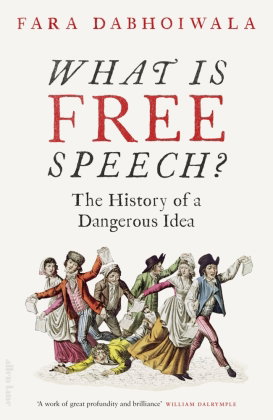
'Eye-opening, thought-provoking and deeply enjoyable, What is Free Speech? is a work of great profundity and brilliance' William Dalrymple
A fresh and exciting approach to one of the most controversial subjects of our time
'Free Speech!' is a clarion call all over the world, yet what it means today is more contested than ever. Many cultures regard it as dangerous: in China, India, and across the Islamic world, unorthodox views about politics, sex, and religion are repressed and people are often punished for expressing them. Even in the western world, where it is held up as a core value, there is widespread discord and disagreement about what freedom of expression means. Amidst perennial imbalances of power, continually evolving cultural taboos, dramatic new technologies and a fast-changing global media landscape, where free speech comes from - and how we might think about it - are critical questions.
Through the lens of history, What Is Free Speech? shows us that freedom of speech is not an absolute from which societies and regimes have drifted or dissented at different times, but something more complicated and interesting.
Our modern conceptions of press and speech liberty, Dabhoiwala shows, were invented in Britain around 1700. The real history of freedom of expression is a story of countless fascinating men and women whose lives have shaped its principles and practices over the past 300 years - slaves and imperialists, poets and philosophers, plutocrats and revolutionaries. Ranging across Europe, North America and South Asia, and not neglecting other parts of the world, Dabhoiwala rejects celebratory platitudes about the past and present of free expression. Instead, his book explains how to think more deeply about free speech as a global as well as a local question - by tracing how we got into our current predicaments, showing that history complicates our contemporary presumptions, and suggesting fresh possibilities for the future.