






Diese Website verwendet Cookies und ähnliche Technologien. Dabei handelt es sich um kleine Textdateien, die auf eurem Computer gespeichert und ausgelesen werden. Indem ihr auf "Alles akzeptieren" klickt, stimmt ihr der Verarbeitung von Daten, der Erstellung und Verarbeitung von individuellen Nutzungsprofilen über Websites und über Partner und Geräte hinweg sowie der Übermittlung eurer Daten an Drittanbieter zu, die eure Daten teilweise in Ländern außerhalb der Europäischen Union verarbeiten (GDPR Art. 49). Einzelheiten hierzu findet ihr in den Datenschutzhinweisen. Die Daten werden für Analysen und für eigene Zwecke Dritter verwendet. Weitere Informationen, auch über die Datenverarbeitung durch Drittanbieter und die Möglichkeit des Widerrufs, findet ihr in den Einstellungen und in unseren Datenschutzhinweisen. Hier könnt ihr mit den notwendigen Tools fortfahren.
- Verlag: Penguin Random House
- Autor: Christine Webb
- Artikel-Nr.: KNV98134268
- ISBN: 9798217178711
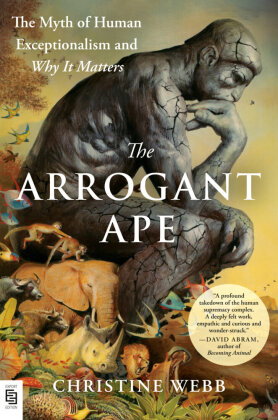
Darwin considered humans one part of the web of life, not the apex of a natural hierarchy. Yet today many maintain that we are the most intelligent, virtuous, successful species that ever lived. This flawed thinking enables us to exploit the earth towards our own exclusive ends, throwing us into a perilous planetary imbalance. But is this view and way of life inevitable? The Arrogant Ape shows that human exceptionalism is an ideology that relies more on human culture than our biology, more on delusion and faith than on evidence.
Harvard primatologist Christine Webb has spent years researching the rich social, emotional, and cognitive lives of our closest living relatives. She exposes the ways that many scientific studies are biased against other species and reveals underappreciated complexities of nonhuman life from the language of songbirds and prairie dogs, to the cultures of chimpanzees and reef fishes, to the acumen of plants and fungi. With compelling stories and fresh research she gives us a paradigm-shifting way of looking at other organisms on their own terms, one that is revolutionizing our perception both of them and of ourselves.
Critiques of human exceptionalism tend to focus on our moral obligation towards other species. They overlook what humanity also stands to gain by dismantling its illusions of uniqueness and superiority. This shift in perspective fills us with a sense of awe and satisfies one of our oldest and deepest desires to belong to the larger whole we inhabit. What s at stake is a better, sustainable way of life with the potential to heal and rejuvenate our shared planet.