






Diese Website verwendet Cookies und ähnliche Technologien. Dabei handelt es sich um kleine Textdateien, die auf eurem Computer gespeichert und ausgelesen werden. Indem ihr auf "Alles akzeptieren" klickt, stimmt ihr der Verarbeitung von Daten, der Erstellung und Verarbeitung von individuellen Nutzungsprofilen über Websites und über Partner und Geräte hinweg sowie der Übermittlung eurer Daten an Drittanbieter zu, die eure Daten teilweise in Ländern außerhalb der Europäischen Union verarbeiten (GDPR Art. 49). Einzelheiten hierzu findet ihr in den Datenschutzhinweisen. Die Daten werden für Analysen und für eigene Zwecke Dritter verwendet. Weitere Informationen, auch über die Datenverarbeitung durch Drittanbieter und die Möglichkeit des Widerrufs, findet ihr in den Einstellungen und in unseren Datenschutzhinweisen. Hier könnt ihr mit den notwendigen Tools fortfahren.
- Verlag: Penguin Random House
- Autor: Jason Roberts
- Artikel-Nr.: KNV98155656
- ISBN: 9781984855220
[An] engaging and thought-provoking book, one focused on the theatrical politics and often deeply troubling science that shape our definitions of life on Earth. The New York Times
A fluent and engaging account of the eighteenth-century origins of Darwinism before Darwin. The Wall Street Journal
WINNER OF THE PEN/E.O. WILSON LITERARY SCIENCE WRITING AWARD A KIRKUS REVIEWS BEST BOOK OF THE YEAR
In the eighteenth century, two men exact contemporaries and polar opposites dedicated their lives to the same daunting task: identifying and describing all life on Earth. Carl Linnaeus, a pious Swedish doctor with a huckster s flair, believed that life belonged in tidy, static categories. Georges-Louis de Buffon, an aristocratic polymath and keeper of France s royal garden, viewed life as a dynamic swirl of complexities. Each began his task believing it to be difficult but not impossible: How could the planet possibly hold more than a few thousand species or as many could fit on Noah s Ark?
Both fell far short of their goal, but in the process they articulated starkly divergent views on nature, the future of the Earth, and humanity itself. Linnaeus gave the world such concepts as mammal, primate, and Homo sapiens, but he also denied that species change and he promulgated racist pseudoscience. Buffon formulated early prototypes of evolution and genetics, warned of global climate change, and argued passionately against prejudice. The clash of their conflicting worldviews continued well after their deaths, as their successors contended for dominance in the emerging science that came to be called biology.
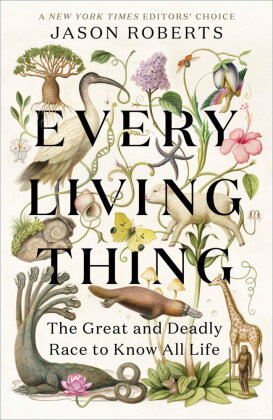
In Every Living Thing, Jason Roberts weaves a sweeping, unforgettable narrative spell, exploring the intertwined lives and legacies of Linnaeus and Buffon as well as the groundbreaking, often fatal adventures of their acolytes to trace an arc of insight and discovery that extends across three centuries into the present day.