






Diese Website verwendet Cookies und ähnliche Technologien. Dabei handelt es sich um kleine Textdateien, die auf eurem Computer gespeichert und ausgelesen werden. Indem ihr auf "Alles akzeptieren" klickt, stimmt ihr der Verarbeitung von Daten, der Erstellung und Verarbeitung von individuellen Nutzungsprofilen über Websites und über Partner und Geräte hinweg sowie der Übermittlung eurer Daten an Drittanbieter zu, die eure Daten teilweise in Ländern außerhalb der Europäischen Union verarbeiten (GDPR Art. 49). Einzelheiten hierzu findet ihr in den Datenschutzhinweisen. Die Daten werden für Analysen und für eigene Zwecke Dritter verwendet. Weitere Informationen, auch über die Datenverarbeitung durch Drittanbieter und die Möglichkeit des Widerrufs, findet ihr in den Einstellungen und in unseren Datenschutzhinweisen. Hier könnt ihr mit den notwendigen Tools fortfahren.
- Verlag: Franz Steiner Verlag
- Autor: Axel Prestes Dürrnagel
- Artikel-Nr.: KNV98225629
- ISBN: 9783515138901
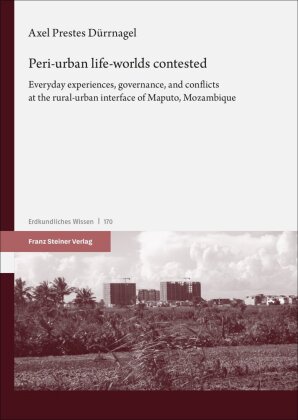
The peri-urban areas of rapidly growing cities in sub-Saharan Africa are the centre of the life-worlds of the continent's future population. Located at the frontier of expanding cities, the rural-urban interface is also characterised by complex governance arrangements, where customary institutions and norms exist in parallel to statutory state law. The persistence of peri-urban spaces and the distinctiveness of peri-urban life-worlds have not received the scholarly attention they deserve, and the failure to understand the perspectives of people living in peri-urban areas ultimately leads to discontinuities and conflicts. Based on the example of the coastal plain of Maputo, the capital of Mozambique, the author explores the intrinsic qualities of everyday life in peri-urban areas and analyses peri-urban governance and conflicts arising in state-society interactions. By combining a phenomenological life-world with an actor-oriented approach, this book shows what it means to be a peri-urban dweller in Maputo and contributes to urban theory in the Global South. Finally, it presents a realistic life-world approach to planning based on the lived experiences of peri-urban life-worlds.