






Diese Website verwendet Cookies und ähnliche Technologien. Dabei handelt es sich um kleine Textdateien, die auf eurem Computer gespeichert und ausgelesen werden. Indem ihr auf "Alles akzeptieren" klickt, stimmt ihr der Verarbeitung von Daten, der Erstellung und Verarbeitung von individuellen Nutzungsprofilen über Websites und über Partner und Geräte hinweg sowie der Übermittlung eurer Daten an Drittanbieter zu, die eure Daten teilweise in Ländern außerhalb der Europäischen Union verarbeiten (GDPR Art. 49). Einzelheiten hierzu findet ihr in den Datenschutzhinweisen. Die Daten werden für Analysen und für eigene Zwecke Dritter verwendet. Weitere Informationen, auch über die Datenverarbeitung durch Drittanbieter und die Möglichkeit des Widerrufs, findet ihr in den Einstellungen und in unseren Datenschutzhinweisen. Hier könnt ihr mit den notwendigen Tools fortfahren.
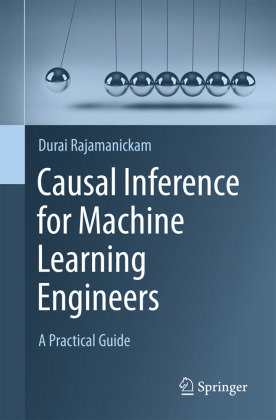
- Verlag: Springer, Berlin
- Autor: Durai Rajamanickam
- Artikel-Nr.: KNV98505086
- ISBN: 9783031996795
This book provides a comprehensive exploration of causal inference, specifically tailored for machine learning practitioners. It begins by establishing the fundamental distinction between correlation and causation, emphasizing why traditional machine learning models primarily focused on pattern recognition often fall short in scenarios that require an understanding of cause and effect. The book introduces core causal concepts, such as interventions and counterfactuals, and explains how these ideas are formalized through tools like causal graphs (Directed Acyclic Graphs, or DAGs) and the do-operator. Readers will learn to identify common pitfalls in observational data, including confounding, selection bias, and Simpson s Paradox, and will understand why these challenges necessitate a causal approach.
Causal Inference for Machine Learning Engineers: A Practical Guide then moves to practical methods for causal estimation, detailing techniques such as regression adjustment, propensity score methods (including matching, stratification, and inverse probability weighting), and instrumental variables. The book delves into advanced topics such as mediation analysis, causal discovery algorithms (PC and FCI), and transportability, providing a roadmap for applying causal reasoning in diverse real-world applications across healthcare, economics, and the social sciences. A significant portion is dedicated to integrating causal inference with deep learning, introducing architectures such as TARNet, CFRNet, and DragonNet, as well as frameworks like Double Machine Learning, all designed to address the challenges of high-dimensional data and improve causal effect estimation in complex settings.