






Diese Website verwendet Cookies und ähnliche Technologien. Dabei handelt es sich um kleine Textdateien, die auf eurem Computer gespeichert und ausgelesen werden. Indem ihr auf "Alles akzeptieren" klickt, stimmt ihr der Verarbeitung von Daten, der Erstellung und Verarbeitung von individuellen Nutzungsprofilen über Websites und über Partner und Geräte hinweg sowie der Übermittlung eurer Daten an Drittanbieter zu, die eure Daten teilweise in Ländern außerhalb der Europäischen Union verarbeiten (GDPR Art. 49). Einzelheiten hierzu findet ihr in den Datenschutzhinweisen. Die Daten werden für Analysen und für eigene Zwecke Dritter verwendet. Weitere Informationen, auch über die Datenverarbeitung durch Drittanbieter und die Möglichkeit des Widerrufs, findet ihr in den Einstellungen und in unseren Datenschutzhinweisen. Hier könnt ihr mit den notwendigen Tools fortfahren.
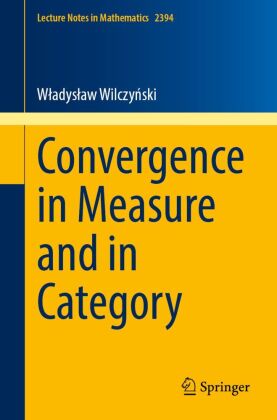
- Verlag: Springer, Berlin
- Autor: Wladyslaw Wilczynski
- Artikel-Nr.: KNV10478535
- ISBN: 9783032231420
This book exhibits a vast gamut of similarities and differences between measure and (Baire) category. An important similarity is the Sierpinski Erdös duality theorem: assuming the Continuum Hypothesis, there exists a one-to-one mapping f of the real line onto itself such that f(A) is a nullset if and only if A is of the first category. Moreover, this mapping can be chosen such that f = f-1. An equally important difference is E. Szpilrajn s theorem: there does not exist a mapping f of the real line onto itself such that f(E) is Lebesgue measurable if and only if E has the Baire property.
Much of the book is devoted to the study of various modes of convergence: convergence almost everywhere; convergence except on a set of first category; convergence in measure; and convergence in the category of sequences of real functions of a real variable. Here, convergence in a category is *-convergence with respect to convergence except on a set of first category, just as convergence in measure is *-convergence with respect to convergence almost everywhere.
The main focus is on sequences of real functions defined on the unit interval. If possible, theorems are proved in the more general setting of an abstract measurable space equipped with a sigma ideal. Sequences of functions that are divergent in measure or in category are also studied. In particular, the possibility of improving, destroying or preserving the convergence is addressed. The book will be valuable for those interested in real analysis and the theory of sequences or series of measurable functions.