


Diese Website verwendet Cookies und ähnliche Technologien. Dabei handelt es sich um kleine Textdateien, die auf eurem Computer gespeichert und ausgelesen werden. Indem ihr auf "Alles akzeptieren" klickt, stimmt ihr der Verarbeitung von Daten, der Erstellung und Verarbeitung von individuellen Nutzungsprofilen über Websites und über Partner und Geräte hinweg sowie der Übermittlung eurer Daten an Drittanbieter zu, die eure Daten teilweise in Ländern außerhalb der Europäischen Union verarbeiten (GDPR Art. 49). Einzelheiten hierzu findet ihr in den Datenschutzhinweisen. Die Daten werden für Analysen und für eigene Zwecke Dritter verwendet. Weitere Informationen, auch über die Datenverarbeitung durch Drittanbieter und die Möglichkeit des Widerrufs, findet ihr in den Einstellungen und in unseren Datenschutzhinweisen. Hier könnt ihr mit den notwendigen Tools fortfahren.
- Verlag: ArchiTangle
- Autor: Andjelka Badnjar
- Artikel-Nr.: KNV10358716
- ISBN: 9783966800440
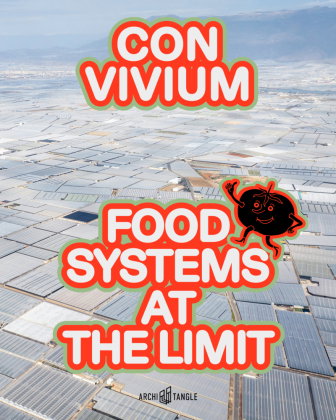
Through a rich interplay of essays, photography, and research, Convivium highlights the environmental, political, and social challenges that define what and how we eat. It asks pressing questions that link ecology and culture, science and design: How do tomatoes connect to salmon? How do barns shape animal lives? And how does soy from Brazil end up feeding livestock in Europe?
Twelve thematic fields structure the book. Contributions on tomatoes, strawberries, salmon, tropical fruit, cows, bulls, octopuses, carp, shrimp, soy, grain, and worms reveal a complex web of trade routes, technologies, and labor relations. Different perspectives demonstrate how food production is linked to climate change, migration, and the transformation of rural and urban spaces. By following these stories, Convivium exposes the hidden infrastructures, economic systems, and spatial consequences of industrial agriculture and global supply chains.
This volume brings together architecture, science, politics, and economics to offer fresh perspectives on how we produce, move, and consume food. Richly illustrated, it combines analytical insight with visual storytelling. It invites readers to rethink the systems behind everyday meals-to see how food shapes the world we inhabit and to imagine more sustainable and equitable ways of living together.
With contributions by Grace Abou Jaoude, Betina Albrecht, Maximilian Atta, Andjelka Badnjar, Sepp Braun, Giulia Bruno, Jean-Marc Caimi, Niklas Fanelsa, Neal Haddaway, Nikolai Huber, Nicole Huminski, Diego Inglez de Souza, Natalie Judkowsky, Nikos Katsikis, Kees de Klein, Andres Lepik, María D. López Rodríguez, Jan Müller, Víctor Muñoz Sanz, Sofia Nannini, Raj Patel, Valentina Piccinni, Stefan Pielmeier, Olga Pindyuk, Réka Rozsnyói, Tiago Saraiva, Katrin Schneider, Johannes Schwartz, Gent Shehu, Rafael Sousa Santos, Carolyn Steel, Amelie Steffen, Sinan von Stietencron, Dániel Szalai, André Tavares, Mark Titley, Öykü Tok, and José Luis Vicente Vicente.