






Diese Website verwendet Cookies und ähnliche Technologien. Dabei handelt es sich um kleine Textdateien, die auf eurem Computer gespeichert und ausgelesen werden. Indem ihr auf "Alles akzeptieren" klickt, stimmt ihr der Verarbeitung von Daten, der Erstellung und Verarbeitung von individuellen Nutzungsprofilen über Websites und über Partner und Geräte hinweg sowie der Übermittlung eurer Daten an Drittanbieter zu, die eure Daten teilweise in Ländern außerhalb der Europäischen Union verarbeiten (GDPR Art. 49). Einzelheiten hierzu findet ihr in den Datenschutzhinweisen. Die Daten werden für Analysen und für eigene Zwecke Dritter verwendet. Weitere Informationen, auch über die Datenverarbeitung durch Drittanbieter und die Möglichkeit des Widerrufs, findet ihr in den Einstellungen und in unseren Datenschutzhinweisen. Hier könnt ihr mit den notwendigen Tools fortfahren.
- Verlag: Wiley-VCH
- Autor: Xue Jiang
- Artikel-Nr.: KNV10361110
- ISBN: 9783527356355
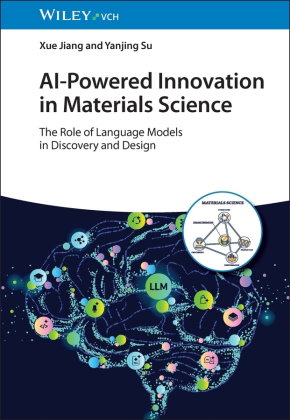
Language models and machine learning are transforming how researchers discover, design, and optimize advanced materials. AI-Powered Innovation in Materials Science: The Role of Language Models in Discovery and Design provides a systematic exploration of these methods, from data mining and predictive modeling to autonomous experimentation. Written by award-winning researchers from the University of Science and Technology Beijing, this reference connects foundational AI theory with practical implementations.
The book covers the evolution of language models in materials science, demonstrating methodologies through real-world case studies in energy, sustainability, and advanced manufacturing applications. Readers gain actionable insights into predicting material properties before experimental validation, optimizing synthesis pathways, and uncovering hidden correlations in materials data. The authors critically analyze current challenges while mapping future directions for materials intelligence research.
You?ll also discover:
* Methodologies for integrating AI throughout the materials research pipeline from initial data mining through autonomous experimentation and discovery workflows
* Practical case studies demonstrating how language models accelerate innovation in renewable energy, aerospace, and high-performance electronics applications
* Frameworks for predictive modeling that minimize costly trial-and-error processes while optimizing synthesis pathways for scalable material production
* Strategies for translating laboratory breakthroughs into practical manufacturing solutions through end-to-end lifecycle management and sustainability considerations
* Critical analysis of current limitations and a comprehensive roadmap for developing next-generation materials intelligence capabilities and research directions
Materials scientists, theoretical chemists, computational scientists, and computer scientists working at the intersection of AI and materials research will find this book invaluable. It provides the theoretical foundations and practical methodologies needed to accelerate materials development for grand challenges in energy, sustainability, and advanced manufacturing.