






Diese Website verwendet Cookies und ähnliche Technologien. Dabei handelt es sich um kleine Textdateien, die auf eurem Computer gespeichert und ausgelesen werden. Indem ihr auf "Alles akzeptieren" klickt, stimmt ihr der Verarbeitung von Daten, der Erstellung und Verarbeitung von individuellen Nutzungsprofilen über Websites und über Partner und Geräte hinweg sowie der Übermittlung eurer Daten an Drittanbieter zu, die eure Daten teilweise in Ländern außerhalb der Europäischen Union verarbeiten (GDPR Art. 49). Einzelheiten hierzu findet ihr in den Datenschutzhinweisen. Die Daten werden für Analysen und für eigene Zwecke Dritter verwendet. Weitere Informationen, auch über die Datenverarbeitung durch Drittanbieter und die Möglichkeit des Widerrufs, findet ihr in den Einstellungen und in unseren Datenschutzhinweisen. Hier könnt ihr mit den notwendigen Tools fortfahren.
- Verlag: Reichert
- Autor: Paolo Borsa
- Artikel-Nr.: KNV10619640
- ISBN: 9783752008524
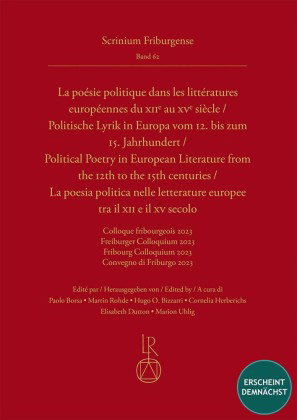
The volume adopts a multilingual and comparative perspective. Contributions are written in French, German, English, and Italian, in accordance with the quadrilingual design of the project. This linguistic plurality is methodologically significant insofar as it enables the study of political poetry across distinct literary traditions without reducing them to a unified interpretive model.
The essays collected here address a range of interrelated questions, including the relationship between poetry and historical events, the political potential of language ("politicity") beyond explicit thematic reference, and the articulation of power, community, and critique through allegorical and formal strategies. Particular attention is also devoted to the circulation and transformation of motifs and poetic techniques across linguistic and cultural boundaries.
By bringing together specialists in medieval European literatures, the volume reconsiders political poetry as a transregional and translinguistic phenomenon embedded in historical contingency. It offers analytical tools for the study of lyric production in relation to political discourse, with special emphasis on the interaction between occasional composition and broader ideological frameworks in medieval Europe. In doing so, the collection contributes to a reassessment of medieval lyric beyond the boundaries of national philologies and discrete literary traditions. It shows how poetic forms operated as instruments of intervention within public and political spheres, while simultaneously participating in the construction of symbolic languages of authority, legitimacy, and conflict. The volume thus provides a framework for further research on political expression in medieval European literature.