






Diese Website verwendet Cookies und ähnliche Technologien. Dabei handelt es sich um kleine Textdateien, die auf eurem Computer gespeichert und ausgelesen werden. Indem ihr auf "Alles akzeptieren" klickt, stimmt ihr der Verarbeitung von Daten, der Erstellung und Verarbeitung von individuellen Nutzungsprofilen über Websites und über Partner und Geräte hinweg sowie der Übermittlung eurer Daten an Drittanbieter zu, die eure Daten teilweise in Ländern außerhalb der Europäischen Union verarbeiten (GDPR Art. 49). Einzelheiten hierzu findet ihr in den Datenschutzhinweisen. Die Daten werden für Analysen und für eigene Zwecke Dritter verwendet. Weitere Informationen, auch über die Datenverarbeitung durch Drittanbieter und die Möglichkeit des Widerrufs, findet ihr in den Einstellungen und in unseren Datenschutzhinweisen. Hier könnt ihr mit den notwendigen Tools fortfahren.
- Verlag: Springer, Berlin
- Autor: Yuko Okamoto
- Artikel-Nr.: KNV10678195
- ISBN: 9789819208432
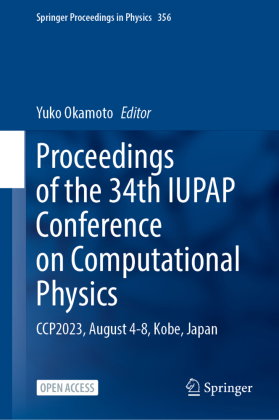
This volume presents the Proceedings of the 34th IUPAP Conference on Computational Physics (CCP2023), held in Kobe, Japan on August 4 8, 2023. It offers a collection of peer reviewed articles that highlight recent developments in computational and simulation research across various areas of physics.
Key topics include the use of data science, quantum computing, and machine learning in physics, providing readers with useful perspectives on these emerging approaches. The articles, contributed by researchers in the field, discuss how computational methods are broadening our understanding of physical phenomena and what kinds of future collaborations may develop from ongoing work. This volume serves as a helpful resource for those interested in the current state and possible future directions of computational physics.
Suitable for graduate students, researchers, scholars, and practitioners, this volume provides free and unrestricted access to its contents. Whether the readers are an experienced specialist or new to the area, the ideas and discussions presented here may support their understanding and encourage further interest in computational physics.
This is an open access book.