






Diese Website verwendet Cookies und ähnliche Technologien. Dabei handelt es sich um kleine Textdateien, die auf eurem Computer gespeichert und ausgelesen werden. Indem ihr auf "Alles akzeptieren" klickt, stimmt ihr der Verarbeitung von Daten, der Erstellung und Verarbeitung von individuellen Nutzungsprofilen über Websites und über Partner und Geräte hinweg sowie der Übermittlung eurer Daten an Drittanbieter zu, die eure Daten teilweise in Ländern außerhalb der Europäischen Union verarbeiten (GDPR Art. 49). Einzelheiten hierzu findet ihr in den Datenschutzhinweisen. Die Daten werden für Analysen und für eigene Zwecke Dritter verwendet. Weitere Informationen, auch über die Datenverarbeitung durch Drittanbieter und die Möglichkeit des Widerrufs, findet ihr in den Einstellungen und in unseren Datenschutzhinweisen. Hier könnt ihr mit den notwendigen Tools fortfahren.
- Verlag: Springer, Berlin
- Autor: Tapan Nayak
- Artikel-Nr.: KNV10705396
- ISBN: 9783032276070
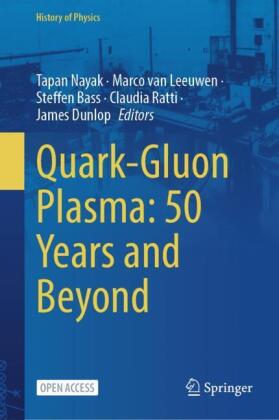
This open-access book celebrates fifty years of the quest to understand quark-gluon plasma (QGP), a form of extremely hot and dense matter that existed in the first microseconds after the Big Bang and may still play a role today in the interiors of neutron stars. Over the past decades, scientists have developed the capability to recreate this extreme state of matter under laboratory conditions through high-energy collisions of heavy atomic nuclei in powerful particle accelerators. These experiments probe the fundamental predictions of quantum chromodynamics - the theory of the strong interaction that binds quarks and gluons into protons, neutrons, and ultimately all atomic nuclei.
The book comprises two parts. The first presents personal reflections by some of the leading scientists who have shaped the field since its early years. The second offers topical reviews that trace the evolution of both theoretical understanding and experimental programs aimed at identifying and characterizing QGP signatures. It provides historical reviews of developments in experimental programs at leading laboratories worldwide, including Brookhaven National Laboratory and CERN, while highlighting future directions in experimental programs at major laboratories.
Overall, this volume takes readers on a reflective and commemorative journey through five decades of progress in the study of quark-gluon plasma: from its theoretical conceptualization to detailed investigations at dedicated experimental facilities, while offering a forward-looking view of this dynamic area of modern physics.