






Diese Website verwendet Cookies und ähnliche Technologien. Dabei handelt es sich um kleine Textdateien, die auf eurem Computer gespeichert und ausgelesen werden. Indem ihr auf "Alles akzeptieren" klickt, stimmt ihr der Verarbeitung von Daten, der Erstellung und Verarbeitung von individuellen Nutzungsprofilen über Websites und über Partner und Geräte hinweg sowie der Übermittlung eurer Daten an Drittanbieter zu, die eure Daten teilweise in Ländern außerhalb der Europäischen Union verarbeiten (GDPR Art. 49). Einzelheiten hierzu findet ihr in den Datenschutzhinweisen. Die Daten werden für Analysen und für eigene Zwecke Dritter verwendet. Weitere Informationen, auch über die Datenverarbeitung durch Drittanbieter und die Möglichkeit des Widerrufs, findet ihr in den Einstellungen und in unseren Datenschutzhinweisen. Hier könnt ihr mit den notwendigen Tools fortfahren.
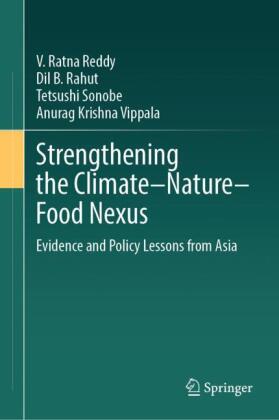
- Verlag: Springer, Berlin
- Autor: V. Ratna Reddy
- Artikel-Nr.: KNV10757571
- ISBN: 9783032294227
This book highlights the interdependencies, trade-offs, and competing demands of climate, nature, and food (C-N-F) constitute a nexus. Managing this nexus ensures the integrity of ecosystem services and sustains natural capital. Before elaborating on the process of nexus, it would come in handy to explain how the terms climate , nature , and food are used in the present context. Climate is mainly used in terms of rainfall and temperature. Extreme events of rainfall and temperatures result in floods and droughts. Here, the terms 'climate' and 'climate change' are used interchangeably as synonyms. Nature includes both use values (natural resources) and non-use values (biodiversity), which include soil, water, forests, habitat, biodiversity, etc. While natural resources like soil, water, forests, biodiversity, etc. (use values of nature) impact food production directly, non-use values (preference, existence, esoteric, etc.) impact indirectly. However, non-use values are not considered in the present analysis, as assessing non-use values is more complex than evaluating the use values. Food production systems primarily include agriculture, forestry, and water-based production systems (such as marine aquaculture). All three production systems are critically linked to nature and are affected by climate change.