






Diese Website verwendet Cookies und ähnliche Technologien. Dabei handelt es sich um kleine Textdateien, die auf eurem Computer gespeichert und ausgelesen werden. Indem ihr auf "Alles akzeptieren" klickt, stimmt ihr der Verarbeitung von Daten, der Erstellung und Verarbeitung von individuellen Nutzungsprofilen über Websites und über Partner und Geräte hinweg sowie der Übermittlung eurer Daten an Drittanbieter zu, die eure Daten teilweise in Ländern außerhalb der Europäischen Union verarbeiten (GDPR Art. 49). Einzelheiten hierzu findet ihr in den Datenschutzhinweisen. Die Daten werden für Analysen und für eigene Zwecke Dritter verwendet. Weitere Informationen, auch über die Datenverarbeitung durch Drittanbieter und die Möglichkeit des Widerrufs, findet ihr in den Einstellungen und in unseren Datenschutzhinweisen. Hier könnt ihr mit den notwendigen Tools fortfahren.
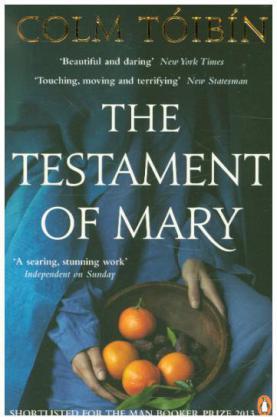
- Verlag: Penguin Books UK
- Autor: Colm Toíbín
- Artikel-Nr.: KNV38135084
- ISBN: 9780241962978
SHORTLISTED FOR THE MAN BOOKER PRIZE 2013
Colm Tóibín's The Testament of Mary is the moving story of the Virgin Mary, told by a novelist famous for writing brilliantly about the family.
From the author of Brooklyn, in a voice that is both tender and filled with rage, The Testament of Mary tells the story of a cataclysmic event which led to an overpowering grief. For Mary, her son has been lost to the world, and now, living in exile and in fear, she tries to piece together the memories of the events that led to her son's brutal death. To her he was a vulnerable figure, surrounded by men who could not be trusted, living in a time of turmoil and change.
As her life and her suffering begin to acquire the resonance of myth, Mary struggles to break the silence surrounding what she knows to have happened. In her effort to tell the truth in all its gnarled complexity, she slowly emerges as a figure of immense moral stature as well as a woman from history rendered now as fully human.
Praise for The Testament of Mary:
'This is a short book, but it is as dense as a diamond. It is as tragic as a Spanish pieta, but it is completely heretical...Tóibín maintains all the dignity of Mary without subscribing to the myths that have accumulated around her' Edmund White, Irish Times
'Depicting the harrowing losses and evasions that can go on between mothers and sons...Tóibín creates a reversed Pièta: he holds the mother in his arms' Independent
'A beautiful and daring work...it takes its power from the surprise of its language, its almost shocking characterization' Mary Gordon, New York Times